Gleanings of the Week Ending September 27, 2025

The items below were ‘the cream’ of the articles and websites I found this past week. Click on the light green text to look at the article.

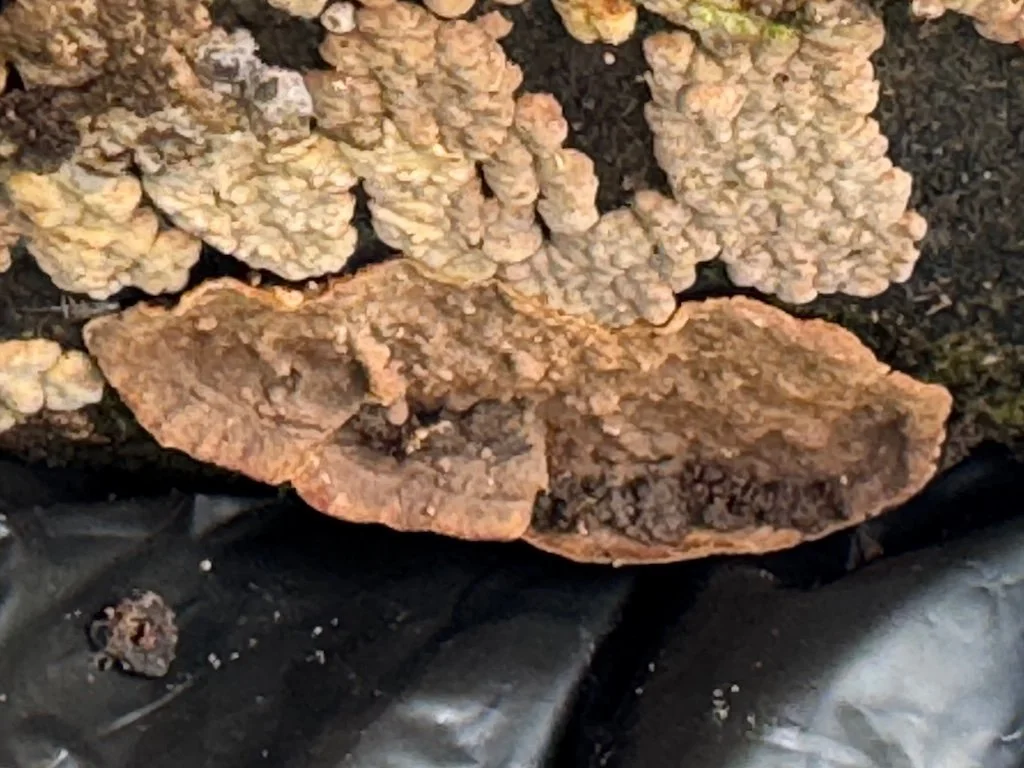
Flamingos reveal their secret to staying young - A decades-long study in France reveals that resident flamingos, which stay put, enjoy early-life advantages but pay later with accelerated aging, while migratory flamingos endure early hardships yet age more slowly. This surprising link between movement and longevity challenges old assumptions and offers new insights into the science of aging.

‘Montana Miracle:’ The State Actually Succeeding at Housing Reform - In 2023, Montana passed a series of state laws aimed at increasing housing construction that included allowing ADUs and legalizing multifamily housing in commercial zones. This year, the legislature doubled down, expanding on the 2023 law and eliminating parking requirements for most units in the state’s 10 largest cities. A new law also eases permitting for manufactured home parks to eliminate the need for a subdivision review when these parks are not subdivided into private lots. Another allows single-staircase buildings up to six stories, making it easier to build denser buildings on smaller lots.

Photographers Capture Underground Pools and Passages of Lechuguilla Cave in New Mexico - So far, 150 miles of Lechuguilla Cave have been explored. With every new survey, the cave offers new insights as to how underground chambers like these are formed and the microbial beings found there. Its beauty earned the entire Carlsbad Cavern National Park the title of a UNESCO World Heritage Site in 1995. But due to its complexity, entrance is limited, with the NPS restricting explorations to highly trained speleologists with pre-approved plans.

Plastic Free Water Filters: Can We Find Water Purifiers without Plastic? – My daughter and I are looking to upgrade our water filters. I hope the water filter technology improves with emphasis on reducing microplastics in water.

Inside Ukrainian Artist Dmitry Oleyn’s Sculptural Approach to Landscape Painting - Rather than use the traditional approach that embraces the flatness of the canvas, the artist instead builds his pigments so there is an element of bas-relief, leaving the surface rugged and with a marked sense of tactility from the artist’s hand. When they are displayed, the irregular surface casts shadows, which when viewed against the painted shadows, is especially intriguing; it also creates a degree of mutability, as depending on the time of day and where the paintings are hung, the lighting of the space dialogues with the work both physically and compositionally.

Photography In the National Parks: Mesa Verde Revisited – I’ve been to Mesa Verde once….back in the 1970s. This article reminded me that I want to go again.

Map Reveals Toxic Pollution Leaking from U.S. Drilling Sites - Scientists have shown that U.S. oil and gas drilling sites are not just leaking methane but also a host of toxic chemicals that pose an urgent threat to the health of those living nearby. A new interactive map details the impact of hundreds of major leaks. At nearly every oil and gas site, leaks also produced benzene, a known carcinogen, as well as other chemicals that have been shown to harm bone marrow, weaken the immune system, impair the nervous system, as well as cause headaches, dizziness, vomiting, and fatigue. Is the fossil fuel industry so arrogant that they don’t care that they are spewing poison (some of which could be used for fuels and other industrial purposes if captured) that negatively impact the health of people and other life?

World’s Tallest Douglas Fir Tree Damaged in Mysterious, Multi-Day Blaze, but It’s Alive After Firefighters Extinguish Flames – It burned from August 16 to August 21. The tree is estimated to be around 450 years old and has a diameter of 11.5 feet. It no longer holds the title of the tallest Douglas fir in the world. However, officials are hopeful the old tree will rebound from the damage wrought by the fire. It’s possible the fir will even grow a new crown.

Six tips from the Middle Ages on how to beat the summer heat – Save the ideas for next summer: work flexibly, wear the right hat, eat to lower body temperature, try wild swimming, use aftersun, or flee.

8 Hints to Reduce Your Food Footprint - You can make food decisions today that change your food footprint. Eight ways you can reduce your food footprint so it’s more environmentally food-friendly: limit ultra-processed foods, curb waste, eat a primarily plant based diet, buy local, compost your food scraps, avoid plastic food packaging (sometimes difficult to do), lose the gas stove, call out Big Ag for its polluting practices.
Gleanings of the Week Ending September 20, 2025

The items below were ‘the cream’ of the articles and websites I found this past week. Click on the light green text to look at the article.

Fewer than half the calories grown on farms now reach our plates - The world produced enough calories in 2020 to feed 15 billion people – but only 50 per cent of those calories ended up reaching people’s plates. This proportion is now very likely to have fallen even lower because of the declining efficiency of the global food system. (This article is behind a paywall…but even the headline and first paragraphs that are freely available are thought provoking.)

Humans inhale as much as 68,000 microplastic particles daily - Every breath people take in their homes or car probably contains significant amounts of microplastics small enough to burrow deep into lungs. The smaller bits measure between 1 and 10 micrometers and present more of a health threat because they can more easily be distributed throughout the body. The concentrations indoors are higher because it is an enclosed environment with high levels of plastic in a small area, and there is generally poor ventilation. The concentration of plastic in the cars’ air was about four times higher than in homes. Researchers matched the microplastic material with that used on the dashboard, door handle, steering wheel and other components. (Makes the case for replacing plastic in home furnishings and air purifiers that remove small particles…the car is more challenging.)

The 25-Ton Stone Relic That Once Lay Hidden Beneath Mexico City - In the winter months of 1790, construction workers were busy repaving the Mexico City’s Plaza de Armas when their shovels struck upon a large, circular object buried in the ground. It was so heavy, they had to create a makeshift pulley system to remove it. Once they did, they were in for a surprise, as they had just discovered one of Aztec civilization’s most iconic artifacts: the Calendar Stone. It is a large sculpture carved into 25 ton, 4 feet-thick circular block of olivine volcanic basalt that measures 11.8 feet in diameter. It was removed from Tenochtitlan’s main square and buried face-down in the ground after the conquistadors conquered Tenochtitlan.

The Paradox of American Technological Leadership in Renewable Energy – From a journalist’s perspective, thriving in a developing nation, dependent on first-world technology.

Earliest Evidence of Indigo Processing Identified on Paleolithic Tools – From analysis of 34,000-year-old stone tools found in the Dzudzuana Cave in the foothills of Georgia’s Caucasus. The pebble grinding tools contained traces of plant matter and indigotin, the deep blue compound also known as indigo.

Global Solar Installations Up 64 Percent So Far This Year - Solar is the fastest-growing source of electricity worldwide, and the buildout continues to gain pace, year after year. In the first six months of 2025, countries installed 380 gigawatts of solar capacity, up from 232 gigawatts in 2024. China accounted for most of the growth, installing more than twice as much solar in the first half of this year as it did in early 2024. For the first time in China, solar isn’t just supplementing coal power, but replacing it. The U.S., by comparison, saw solar installations rise by just 4 percent. Through its exports of low-cost solar panels, China also drove growth in India and across much of Africa

Permitting Pollution Jeopardizes Clean Water - The PERMIT Act, will let large-scale polluters off the hook for trashing our waters, leaving the American people to pick up the tab. If it becomes law, this bill will pollute our drinking water, compromise our health, put more communities at risk of floods, and ruin many of the places we swim or fish.

How long can one RSV shot protect seniors? Study shows surprising two-year shield - A single RSV vaccine dose is proving to be a powerful shield for older adults, significantly reducing hospitalizations and severe illness over two consecutive RSV seasons. While protection is strongest in the first year and declines somewhat in the second, the findings highlight both the immediate benefits and the importance of ongoing monitoring.

84% of Chicago's Pipes Contain Lead — and They're Not Equally Distributed - Chicago has the highest number of lead water service lines in the nation, with an estimated 412,000 of about 491,000 lines at least partly made of lead or contaminated with the dangerous metal. The city’s Black and Latino communities are most impacted, but the issue is widespread across the city’s water distribution network.

How to Go Plastic Free for Beginners. Your First 10 Items! - Start with 10 items, step by step and then progress slowly to more once you feel more confident.

Gleanings of the Week Ending September 13, 2025

The items below were ‘the cream’ of the articles and websites I found this past week. Click on the light green text to look at the article.

Can Italy Protect Its Cultural Heritage from Naughty Tourists? - Each summer, as millions of tourists swarm into historic towns full of monuments and museums, a predictable kind of headline is sure to follow about badly behaved tourists putting cultural heritage at risk.

Bans on highly toxic pesticides could be a simple way to save lives from suicide - Pesticide poisoning is a common method of suicide in many low- to middle-income countries. Substituting highly toxic pesticides for less fatal ones can save lives. A cast study from Sri Lanka.

Federal Hurricane Forecasting Saves Lives & Money - A 5-day forecast in 2025 is roughly equivalent to a 2-day forecast in 2005, meaning lead times and path estimates have significantly improved, to the tune of 50% in the past 20 years. This helps save lives and has also led to an estimated 2 billion dollars in savings per storm. NOAA’s research arm, the Office of Oceanic and Atmospheric Research (OAR), houses not only the laboratories that help improve predictions, but much of the monitoring and observation infrastructure — like ocean buoys and gliders — that feed real time data into hurricane models, improving their accuracy and saving lives. The U.S. fully relies upon NOAA for our hurricane forecasts, including sea level rise and flooding. There is no other body ready or funded to pick up that work. The President’s budget proposed completely eliminating the research arm of NOAA.

Bison Benefits - A new study out this past week explains why bison are more beneficial for grasslands than traditional livestock, and the benefits increase as herd size does. A podcast from National Parks Traveler.

4 Reasons to Choose Plastic Free, All Natural Fibers Over Synthetic Fibers - Manufacturers give our fabrics trade names, so even when we look at the fiber content label inside our clothing, it isn’t clear that it is made from plastic. Buying clothing that is made from natural fibers is the fastest and safest way to save our planet.

An Explosive Beginning for Lake Bosumtwi - Bosumtwi’s exotic geology has drawn attention to the crater for economic reasons as well. When the asteroid struck, the shockwave fractured the crust around the crater, creating an extensive network of faults and cracks that allowed hot fluids to circulate. The event helped concentrate gold and other minerals from a gold-bearing rock layer called the Birimian Supergroup near the surface and primed the area around the crater to become a target of small-scale gold mining.

Common painkillers like Advil and Tylenol supercharge antibiotic resistance - Researchers discovered that these drugs not only fuel bacterial resistance on their own but make it far worse when combined with antibiotics. The findings are especially troubling for aged care settings, where residents commonly take multiple medications, creating perfect conditions for resistant bacteria to thrive.

See the Rare ‘Electric Blue’ Lobster Found Off the Coast of Massachusetts – A video showing a vibrantly colored shell that results from a genetic mutation affecting pigmentation.

New Jersey Cats Caught on Camera – Bobcats caught on camera traps…and other animals in the wilds of New Jersey.

Traveling Photographer Spends 17 Years (And Counting) Documenting Indigenous Cultures – Faces and clothes from around the world.

The surprising foods that lead to better sleep - It seems that a plant-rich diet is the most beneficial for sleep, for numerous reasons – and that eating at consistent times throughout the day – for those who can – may also help.

Plastics Crisis – Trash Inventory

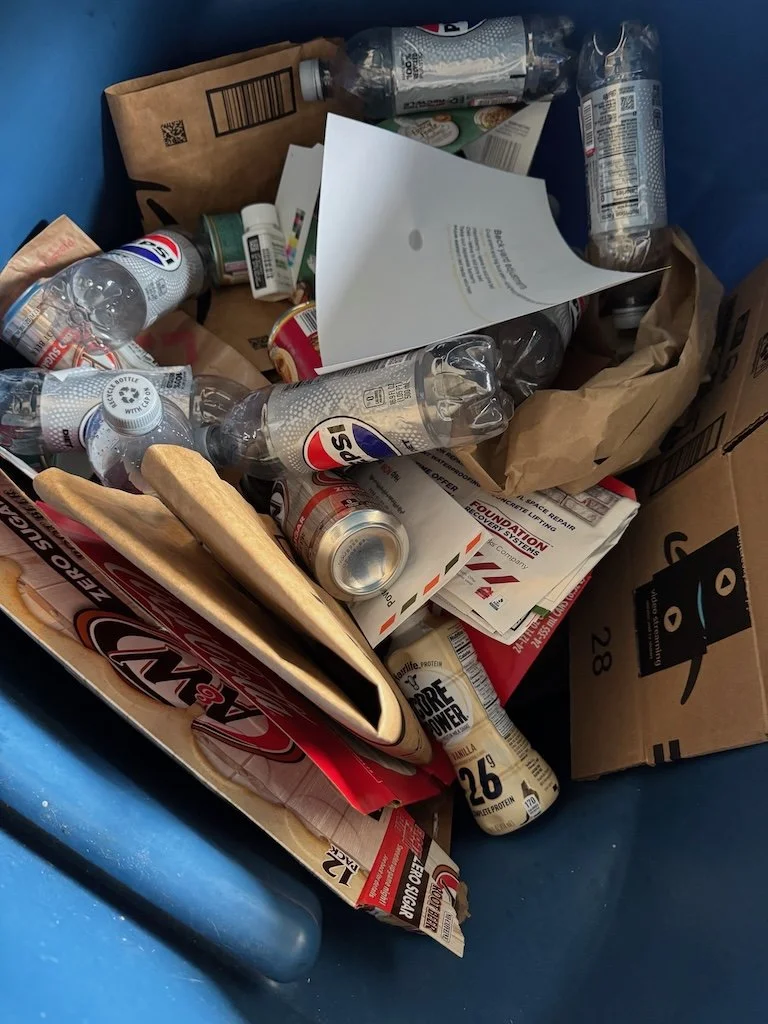
I wrote about plastics I recycle a few days ago. Today I am focused on the plastics that end up in my trash.

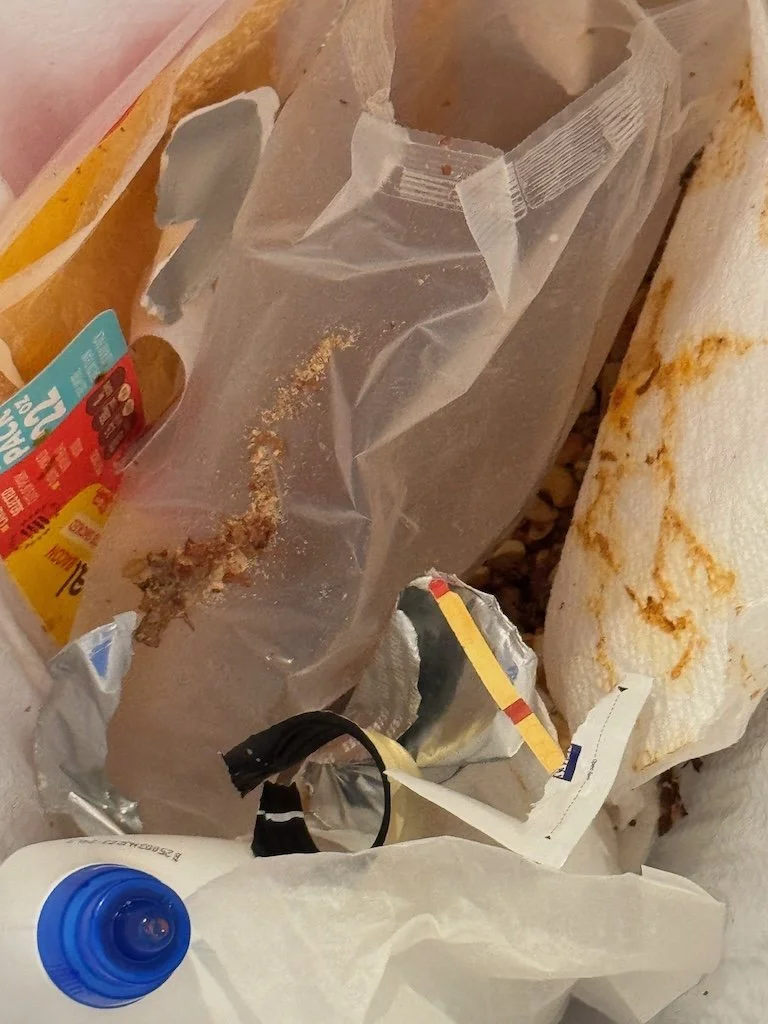
There are little bits of plastic packaging - mostly wrappers from lens/screen wipes, single serving electrolyte powder, and protein bars. There are probably alternatives to a lot of these little bits of plastic packaging: Could we go back to small spray bottles and cloth/tissue wipes for our glasses, phones, and screens? Probably we should. Perhaps I can buy a cardboard container of powdered electrolytes rather than single serving packages; there is still a plastic lid and does not work that well for travel. Maybe I should start thinking about protein bars as ultra processed food and develop a homemade version that isn’t…or eat nuts rather than protein bars.

There is plastic packaging from raw meats like bacon and hamburgers and chicken. It seems like all meat is packed in plastic these days. And it is plastic that is messy…and not in a form that can be recycled. It is touching the food and could easily be adding microplastics. There are not a lot of good alternatives although sometimes buying frozen meat means that the plastic is not clinging to it (for example: Bubba burgers and bags of frozen boneless chicken breasts). There is not an alternative to bacon plastic packaging that can think of. Before plastic – meat was often wrapped in white paper – still messy trash but not plastic.

Bottles that are too messy to recycle easily. I tend to not recycle toilet bowl cleaner bottles; they are too difficult to get clean. I am going to experiment with homemade toilet bowl cleaner (soda, cleaning vinegar, lemon essential oil). Peanut butter is another plastic container that is difficult; I put dish detergent and water in it and after some soaking it will be clean enough…but glass come clean more easily so my preferred solution is to buy peanut butter in glass; it is better that food does not touch plastic!

I don’t use straws often but when I do, I try to use paper ones, so I have eliminated that form of plastic trash – at least when I am at home.

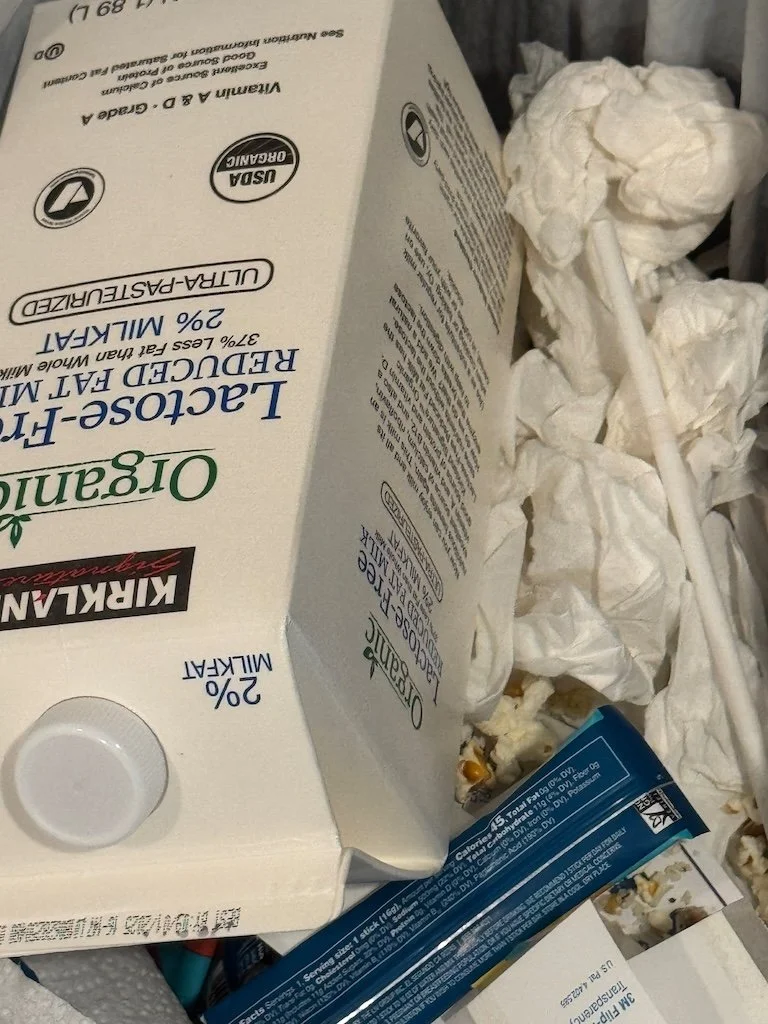
Plastic-coated paper cartons are another form of plastic in my trash. They are not recyclable like the cartons of the 60s would have been. It is unfortunate that in many markets it is hard to buy milk in anything but plastic (jug or plastic-coated carton). I am close to just deciding to pay a lot more to get milk in glass containers…..and to start writing letters to companies about packaging their product in a more healthy and sustainable way. Or – I might decide to not drink milk…somehow make up the nutritional value in other ways.

Bottom line – there is a significant amount of plastic in my trash…not as much as in the recycle bin but still a far amount. It will be in the landfill for a long time and contributing microplastics to the leachate that is, in the best case, sent to a sewage treatment plant that will pass at least some of those microplastics (maybe the smaller ones) through to the river after treatment. Eventually the microplastics can find their way into our water supply (the water treatment plants do not currently take out microplastics) or into our food if the water from the river is used for irrigation of crops.

Previous Plastic Crisis posts

Plastics Crisis: Recycle Inventory

I have been recycling for a long time…starting out when newspapers and cans (separately) were the only items that could be recycled. By the time we moved from Maryland, the county where we lived supplied recycle bins for everyone; the cost was included with trash service. The items we recycled included cardboard, paper, glass jars/bottles, tin cans, aluminum cans, plastic bottles/jugs, and milk cartons/juice boxes. We always had more in the recycle bin than in the trash bin and that seemed true for everyone in our neighborhood.

When we moved to Missouri, the curbside recycling was an added cost beyond trash pickup and we quickly discovered that not as many people recycled. The list of recyclables did not include glass or milk cartons/juice boxes. The local recycling center accepts glass, so we periodically take glass there. The milk cartons/juice boxes go into the trash. We still have more in our recycling bin than in trash. The bulk is cardboard/paper, but the next is plastic…followed by tin/aluminum cans.

Focusing in on the plastic that is in our recycling bin….

  • There are soft drink bottles…but those will be going away shortly because I will either stop drinking soft drinks or buy them in aluminum cans.

  • There are milk jugs. I buy milk in jugs rather that cartons because the jugs can be recycled. There are not plastic free options for milk since even the cartons have plastic coating them.

  • There are a few cleaned-out bottles with caps. It is not as clear that these plastics are always recycled; for that reason, I am actively trying to reduce/eliminate them. I have already eliminated laundry detergent (buying laundry sheets in paper packaging instead). I sometimes don’t recycle bottles that held products that are hard to clean out (peanut butter, for example) and plan to buy those things in glass from now on which is more reliably recycled. I also am experimenting with DIY toilet bowl cleaner (soda, vinegar, essential oil) rather than buying the bottled version.

  • Plastic bags are collected and taken back to stores that accept them for recycling; I am skeptical that they are recycled but it is challenging to find out what really happens to them. They are usually not plastic shopping bags these days since we use reusable bags so frequently. They are bread bags, plastic from around soft drinks (although we are getting better at avoiding that), plastic bags that held food (popcorn, produce), packaging from clothing purchases, air ‘pillows’ from packaging, toilet paper packaging). I am overtly trying to reduce or eliminate this type of material even though it is supposedly recycled.

Even with all the effort I put into recycling of plastic – a lot ends up in the trash because it is not recyclable and even some of the plastic that enters the recycling process ends up in landfills because it is cheaper to make new plastic rather than to process recycled plastic!

We cannot recycle our way out of the plastic crisis! Read The May 2022 report The Real Truth About the U.S. Plastics Recycling Rate from Beyond Plastics. It documents a recycling rate of just 5-6% for post-consumer plastic waste in the U.S. for 2021. The report also reveals that while plastics recycling is on the decline, the per capita generation of plastic waste has increased by 263% since 1980. The failure of plastic recycling is in contrast to paper which is recycled at 66% (2020 figure per American Forest and Products Association). High recycling rates of post-consumer paper, cardboard, and metals proves that recycling works to reclaim valuable natural material resources. It is plastic recycling that has always failed as it has never reached 10% even when millions of tons of plastic waste per year were counted as recycled when exported to China.

Previous Plastic Crisis posts

Gleanings of the Week Ending September 6, 2025

The items below were ‘the cream’ of the articles and websites I found this past week. Click on the light green text to look at the article.

Too much salt can hijack your brain – In a study using rats, researchers showed that a high-salt diet activated immune cells in a specific brain region, causing inflammation and a surge in the hormone vasopressin, which raises blood pressure. Researchers tracked these changes using cutting-edge brain imaging and lab techniques that only recently became available.

Two-Thirds of River Trash Is Plastic - Recent research conducted at the University of California–Santa Barbara found that rivers have far too much plastic in them. 1.95 million metric tons of plastic — the weight of 5.3 Empire State buildings — travels down rivers worldwide every year. It comes from littering, illegal dumping, leakage from landfills…and is mobilized across landscapes, through urban drainages, and into waterways by wind and rains. And it isn’t harmless. Microplastic in rivers accumulates in food sources, and direct exposure via inhalation and consumption of water leads to direct accumulation in our bodies. Macroplastic in rivers affects our infrastructure and communities by blocking drainages, exacerbating flood risk and damage, and negatively affecting tourism, fisheries, and shipping. And plastic also impacts the river ecosystem and biodiversity via wildlife entanglement, ingestion, and smothering, leakage of chemical additives, and transport of non-native species and pathogens. Plastic continues to break down into smaller and smaller pieces. As microplastic breaks down, it becomes nanoplastic…which might be the most dangerous to health of living things – including humans.

'I had no idea it would snowball this far': Why a Brazilian favela facing eviction decided to go green - Favelas – or Brazilian slums – are widespread informal settlements often situated on the periphery of major cities such as São Paulo and Rio de Janeiro. They are home to low-income populations and can be built precariously on unstable land such as slopes and hills. They are often underserved in formal infrastructure – meaning they can be especially vulnerable to climate impacts and risks such as landslides – and commonly don't have access to public services such as sanitation. The post is about one favela that cleaned up trash/waste…built a garden.

These Lizards Have So Much Lead in Their Blood, They Should Be Dead. Instead, They’re Thriving – Brown anoles (non-native…native to Caribbean) around New Orleans since the 1990s. They are not physiologically impaired by the high levels of lead in their bodies.

Canadian Archaeologists Excavate Homestead of Black Rancher John Ware – He arrived in Canada in 1882…herding 3,000 head of cattle and settled near Millarville, Alberta.

In Scotland, Whale Strandings Have More Than Tripled - Over the past three decades, the number of whale strandings in Scotland has grown dramatically. Scientists say pollution and industrial noise may be driving the losses.

What Is High-Quality Prairie Anyway? - What are the criteria we should use for evaluating prairies?

Pic for Today – I saw more Jewelweed in Maryland than I do in Missouri….but always enjoy spotting it…I couldn’t resist adding this post to the gleanings this week.

113-Year-Old Bathhouse Being Restored at Hot Springs National Park – Glad the Maurice Bathhouse is going to be rehabilitated; it has been closed since 1974.

Scientists finally crack the secret to perfect chocolate flavor - Scientists have decoded the microbial and environmental factors behind cacao fermentation, the critical process that defines chocolate’s taste.

Plastics Crisis: As an Individual

We cannot eliminate micro and nano plastics from our lives. They are in the air we breathe, the water we drink, the food we eat, and the toiletries we use. They are in us – our lungs, our heart, our kidneys, or brain…everywhere. The impact on our health is something that develops over long exposure/accumulation; research studies are just now beginning to clarify their impact. It is possible to reduce our exposure, and we probably need to do what we can to stay healthy as long as possible. This post is about my initial strategy to reduce micro and nano plastic exposure for myself and my family.

Air

The air purifiers that we bought during the COVID-19 pandemic are still running in our bedroom and my office. They help with seasonal allergies and take out some of the plastics in the air.

I try to reduce time outdoors when the air quality is yellow and avoid going outside if the air quality is red. The PM2.5 (Particulate matter less than 2.5 microns) is almost always the major contributor to the air quality ‘color’ in the area where I live and it includes microplastics. It might not be counting nano-plastics effectively and there are probably some in the air; those are the plastics small enough to move through capillaries in our bodies; hopefully these smaller particles will start being monitored more effectively.

Water

I currently filter the water we drink with Brita Elite water pitchers. They get some of the plastics out of our water. My daughter and I are talking about upgrading…perhaps all the way to reverse osmosis filtration. I have a glass carafe for filtered water in the bathroom since I am always thirsty when I first get up.

We always carry stainless steel water bottles with us when we are out and about. When we leave home they contain filtered water.

On overnight trips, we are taking a filtration pitcher with us so that we can easily refill our water bottles with filtered water. If we need to buy something to drink, we strive to buy it in a can, glass, or paper container….but sometimes that is difficult. I am tempted to ask if I can buy a drink but use my refillable stainless steel container rather than a Styrofoam or plastic cup.

We try to avoid plastic water bottles completely. The plastic sluffs off microplastics – particularly if the bottle has ever been warm.

We don’t use plastic glasses at home…and don’t eat out frequently except when we travel.

Food

Micro plastics are often found in soil and can be absorbed by plants as they grow so they can be in the veggies and fruit we eat, and they accumulate in the animals that provide meat that we eat. Organic foods will have microplastics too; they might even have more plastic since organic farms sometimes use plastic sheeting to avoid the need for chemical weed control and to conserve water around the base of plants. There is not much that can be done to reduce the microplastics that are integrated into our food in this way.

Packaging is another way microplastics can be incorporated into food and there are actions that can be taken to reduce this source of microplastics.

  • Buy fresh fruits and vegetables unpackaged. Use reusable produce bags. Don’t store them in the bags either – particularly if the bags are a synthetic fabric.

  • Buy in glass rather than plastic jars and bottles. Prioritize fatty and acidic foods to buy in glass if you are on a budget. Peanut butter and olive oil are examples of fatty foods. Lemon juice, soft drinks (not a health food ever but even less healthy in plastic), spaghetti sauce, and salad dressing/vinegars are examples of acidic foods. Sometimes this is difficult since some stores only carry the commodity in plastic packaging.

  • Meats are almost always packaged in plastic now, so it is almost impossible to avoid. I buy some meats frozen so that the plastic is not closely touching the food and when there is a canned version (canned chicken, canned chili, canned tamales), I take that option sometimes.

  • Consider making some condiments from scratch (salad dressing, marinade). I already make my own marinade with basaltic vinegar and olive oil. I am going to experiment with making salad dressing so that I can forego buying it pre-made in a plastic bottle.  

  • Avoid plastic bags of things like popcorn (I rarely use the pre-packaged microwave popcorn), pumpkin seeds, or beans. Buy them in bulk (often you can use produce bags to get them from the store to home) and load up glass or metal canisters once  at home. Frequenting a store with a bulk food section will be a continuing experiment for me…the goal will be to reduce plastic containers touching food in my home.

  • Store leftovers in and eat from  glass or ceramic or stainless steel rather than plastic. Use stainless steel or wooden utensils. My cutting board is bamboo.

  • Cook in stainless steel – uncoated – pans.

  • Don’t heat or reheat food in plastic. Glass or ceramic always.

  • Buy eggs in pulp paper cartons rather than Styrofoam or plastic cartons. The eggs probably don’t get much microplastic from their container, but the pulp paper is generally the superior carton, and, like all the above measures, it reduces the plastic trash/recycle load to the environment.

Toiletries

Some plastic is small enough to be absorbed through the skin. There are two sources of plastics in toiletries: packaging and ingredients.

I try to buy cosmetics in glass. Usually this is possible for moisturizers and foundation makeup. There don’t seem to be good alternatives to plastic packaging for most items like shampoo, toothpaste, lotion, lipstick, or lip balm. I have started using bar soap which usually comes in paper wrapping or a box for hand washing and in the shower.

The ingredients in many cosmetics are sometimes microplastics or contain the same chemicals as microplastics. It’s very confusing…I don’t have a good strategy yet to fully understand the risk or how to avoid the worst offenders. I do realize that fewer ingredients is generally better and that maybe some ‘make your own’ would be better (for example, a water – glycerin – essential oil mixture in a glass bottle might be a good replacement for setting spray).

Previous Plastic Crisis posts

Gleanings of the Week Ending August 30, 2025

The items below were ‘the cream’ of the articles and websites I found this past week. Click on the light green text to look at the article.

How Do Plants Know It’s Getting Hot? - Over the past decade, scientists have identified a few temperature sensors that regulate plant growth, some of which also detect light. Many of the experiments to understand the function of these sensors were done in the dark, leaving daytime temperature sensing unexplored. Now, in a recent study researchers discovered a brand-new role for sugar in daytime temperature sensing. They showed that at high temperatures, sugar acts as a thermostat to override plant-growth brakes, thus enabling heat-responsive stem elongation. These findings could pave way for breeding climate-resilient crops in the face of global warming.

Volunteers Discover 115-Million-Year-Old Dinosaur Tracks Revealed in the Wake of Devastating Texas Floods - Last month’s extreme floods in central Texas have uncovered 115-million-year-old dinosaur tracks in Travis County, which includes Austin. While the discovery is overshadowed by the deaths of more than 138 people at the hands of the very same natural disaster, it sheds further light on the state’s richly preserved paleontological history.

Horseshoe Crabs Break Free from Biomedical Testing - For 40 years, researchers relied on horseshoe crab blood to catch endotoxins in drugs. Now, synthetic alternatives and updated regulations can end the practice.

Cultivating for color: The hidden trade-offs between garden aesthetics and pollinator preferences - There are native plants with colorful and interesting flowers that bloom at different times, from early spring to late fall. These plants tend to produce reliable floral signals and offer the nectar and pollen needed to support pollinator nutrition and development.

Ancient Dental Plaque Unearths Prehistoric People’s Lifestyle - Tartar on ancient teeth is the oral microbiome fossilized over time. When researchers sequenced the genetic material isolated from ancient tartar, they found it teeming with bacterial DNA. The researchers identified several pathogenic bacteria and some antibiotic resistance genes, suggesting that the potential for antibiotic resistance was present in prehistoric times. Several bacteria such as those belonging to the genera Streptococcus and Actinomyces coexisted with humans through their evolution, offering insights into microbial health and disease through the ages.

An interstellar visitor and hairy caterpillars: The best science pictures of the week – From the BBC.

One small walking adjustment could delay knee surgery for years - A groundbreaking study has found that a simple change in walking style can ease osteoarthritis pain as effectively as medication—without the side effects. By adjusting foot angle, participants reduced knee stress, slowed cartilage damage, and maintained the change for over a year. The caveat: Before this intervention can be clinically deployed, the gait retraining process will need to be streamlined.  

A 2,000-Year-Old Sun Hat Worn by a Roman Soldier in Egypt Goes on View After a Century in Storage - A Roman soldier in ancient Egypt dealt with the excruciating power of the sun roughly 2,000 years ago: by donning a felt cap.

Amazon & Brimstone Advance Lower-Carbon Cement Collaboration - Brimstone developed a breakthrough process to co-produce multiple industrial materials, including portland cement, supplementary cementitious materials, and smelter grade alumina. The company was founded in 2019 to develop next-generation industrial processes optimized for economics, efficiency, and sustainability. The companies announced they signed a commercial agreement to secure a future supply of Brimstone’s materials in the coming years, pending successful completion of testing and commercialization to scale up requirements.

As Fire Season Ramps Up, Thousands of U.S. Firefighting Positions Are Vacant - ProPublica’s review of internal agency data found that more than 4,500 Forest Service firefighting jobs — over one-fourth of all the agency’s firefighting jobs — were vacant as of July 17. The Guardian also reported that vacancy rates were highest in the Pacific Northwest and Intermountain Regions, at 39 percent and 37 percent respectively. Even before all the layoffs and resignations this spring — the Forest Service sometimes struggled to get through busy fire seasons. Firefighters have been called in from Canada, Mexico, and Australia when resources are stretched too thin, and sometimes National Guard or military troops are deployed.

Plastics Crisis: Getting Focused

In early August, I saw an article that made the point that the World Cannot Recycle Its Way Out of Plastics Crisis. A few days later, I saw the notice for a community workshop about using less plastic and I registered. They sent out a list of documentaries and webinars to view prior to the workshop. I viewed almost all of them; they were all good and thought provoking but the tipping point for me was Dr. Megan Wolff’s webinar on plastics and health presented for Missouri River Bird Observatory in March 2025; I highly recommend viewing this in its entirety to everyone that is concerned about health of the planet and every living thing on it, including ourselves.

I have been concerned about single use plastics for the past few years. Stories reporting about how microplastics (and nanoplastics) being found in more and more parts of our bodies keep coming out …and how they are damaging to health. Most of the data has been correlations, but recent research it pointing to the details of how the small bits of plastic cause problems.  

A few days after watching the video, the news came out: Global plastic treaty talks end in failure as countries remain bitterly divided over how to tackle the crisis. There was an attempt to hold out some hope: Plastic pollution treaty talks adjourn, but countries want to ‘remain at the table’: UNEP chief. I wondered how many people even noticed the news. I did another search and found a bit more information: How a global plastic treaty could cut down pollution—if the world can agree on one. The articles name Saudi Arabia, Russia, and Iran and the large presence of people working for oil and gas firms and plastic manufacturers as the group that wants to ‘manage waste’ instead of capping production (and if production is not capped it is projected to climb dramatically). Based on a story from Reuters it appears that the United States, the world's number two plastics producer behind China, should have been listed with the three other countries blocking a deal. One positive development was that top plastics producer China publicly acknowledged the need to address the full-life cycle of plastics.

I am planning to do a series of posts on the Plastics Crisis as I learn more…as I search for a course of action that can make a difference. My next post will be after I attend the workshop.

Gleanings of the Week Ending August 16, 2025

The items below were ‘the cream’ of the articles and websites I found this past week. Click on the light green text to look at the article.

Fall 2025 International Student Enrollment Outlook and Economic Impact – The drop in new international student enrollment in the United States this fall could result in a 15 percent drop in overall enrollment. This drop would result in nearly $7 billion in lost revenue and more than 60,000 fewer jobs.

Woodpeckers thrive where missiles fly. How a bombing range became a wildlife refuge - A U.S. Air Force bombing range in Florida has become a sanctuary for endangered species like the red-cockaded woodpecker!

Used EV Batteries Get New Life Supporting the Texas Power Grid - In Texas, retired EV batteries are being repurposed to shore up the state’s unstable electric grid. Batteries have made significant capacity contributions within Texas’ electric grid in recent years and have been credited with helping prevent summer blackouts by bolstering grid reliability.

World Cannot Recycle Its Way Out of Plastics Crisis - The world churns out more than 200 times as much plastic today as it did in 1950, and production is only rising. Microscopic bits of plastic waste have been found nearly everywhere. Many of the more than 16,000 chemicals used in plastics — flame retardants, fillers, dyes — can harm human health, and fetuses, infants, and young children are particularly vulnerable. Without efforts to stem the use of plastic, production is on track to nearly triple by 2060.

Gorgeous, Hidden Animal Tattoos Discovered on a More Than 2,000-Year-Old ‘Ice Mummy’ by Using Digital Imaging - Tigers, stags and a leopard twist around each other, the animals’ stylized and intricate details spread in ink across a woman’s forearm. On her hand is the delicate outline of a bird with a fluffy tail. It sounds like something you might see from a tattoo artist today, but these designs appear to be preserved on a more than 2,000-year-old “ice mummy” from Siberia’s Pazyryk culture.

How do the microplastics in our bodies affect our health? - The use of plastics in society first came into being on a large scale in about the 1920s, and we see a big increase from the 1960s onwards. In a study published in 2024, scientists found that consumption of the particles has increased sixfold since 1990, particularly in various global hotspots including the US, China, parts of the Middle East, North Africa and Scandinavia. In February 2025, scientists identified microplastics in the brains of human cadavers. Most notably, those who had been diagnosed with dementia prior to their death had up to 10 times as much plastic in their brains compared to those without the condition. Because humans are consuming so many different types of plastic, it's both unlikely and impractical, without vast sources of funding, for researchers to be able to identify a direct link between ingesting microplastics and one particular disease….but there is mounting evidence that they are impacting health.

See the Faces of Two Sisters Who Toiled Away in a Neolithic Mine 6,000 Years Ago – Skeletons found in the Czech Republic chert mine.

This diet helped people lose twice as much weight, without eating less - People eating minimally processed foods lost twice as much weight as those on ultra-processed diets, even though both diets were nutritionally balanced and participants could eat freely!

A Promised U.S. Drilling Boom Has Yet to Materialize - The price of oil, the world’s most-traded commodity, is more responsive to global demand and supply dynamics than to domestic policy and politics. The economics of solar and wind are increasingly too attractive to ignore. They are now almost always the least expensive — and the fastest — option for new electricity generation.

Your sleep schedule could be making you sick, says massive new study - A global study of over 88,000 adults reveals that poor sleep habits—like going to bed inconsistently or having disrupted circadian rhythms—are tied to dramatically higher risks for dozens of diseases, including liver cirrhosis and gangrene.

Volunteering – August 2023

I have three areas of volunteering going on this summer: Friends of the Library, Master Naturalist chapter, and Butterfly House (that counts as Master Naturalist hours too).

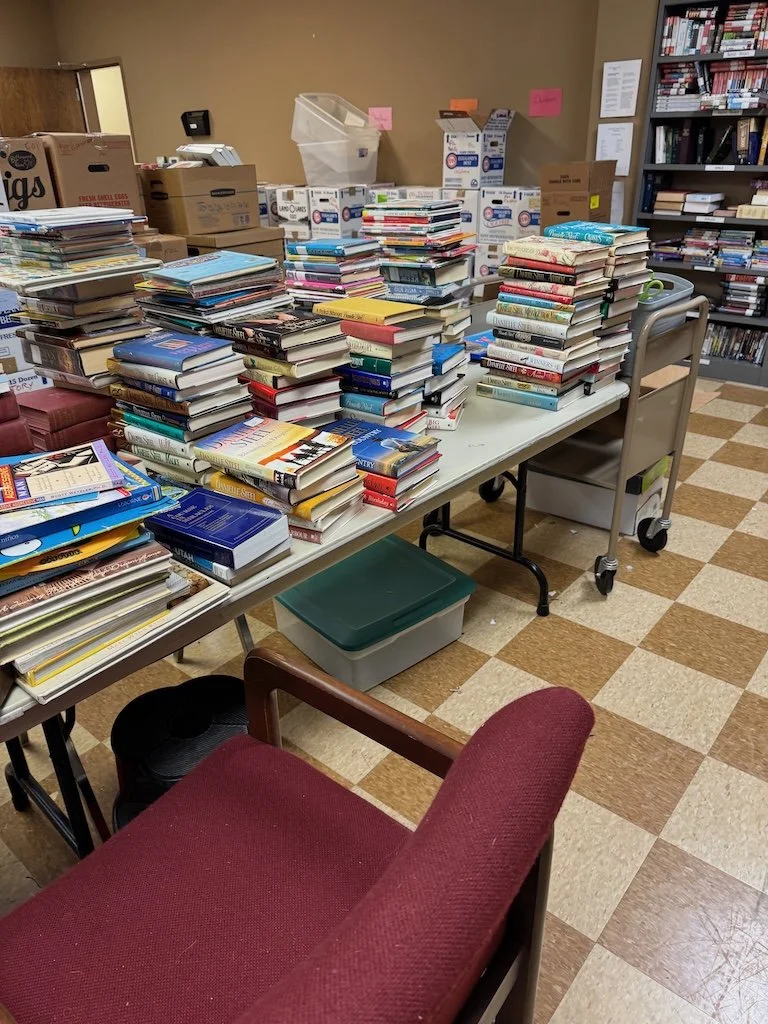
I volunteer once a month to sort used books at my local library that will be sold in the sales that happen once a year at each branch. Setting up or helping during the sale itself is another volunteer opportunity (I prefer the set up!). This month the sale will be at the branch closest to where I live but I have used the sales as an opportunity to explore other the parts of the county that I am not as familiar with. The monthly sorting usually starts out a bit daunting with tables full of books that have been donated. Two people come in each week but there are certainly times that there is more than two people can sort into shelving by subject or box up within the 2-hour shift. I am always relieved when the table is cleared when I leave…and that the area is air conditioned; sorting books is good exercise.

I am the programs chair for my local Missouri Master Naturalist chapter, so I am doing the behind-the-scenes activity to arrange for speakers…and writing announcements to the chapter about what is happening. The speakers count as advanced training so I create an entry in the tool we have for logging our advanced training so that others can simply select it when they attend…minimizing what they must do to get credit for the training.

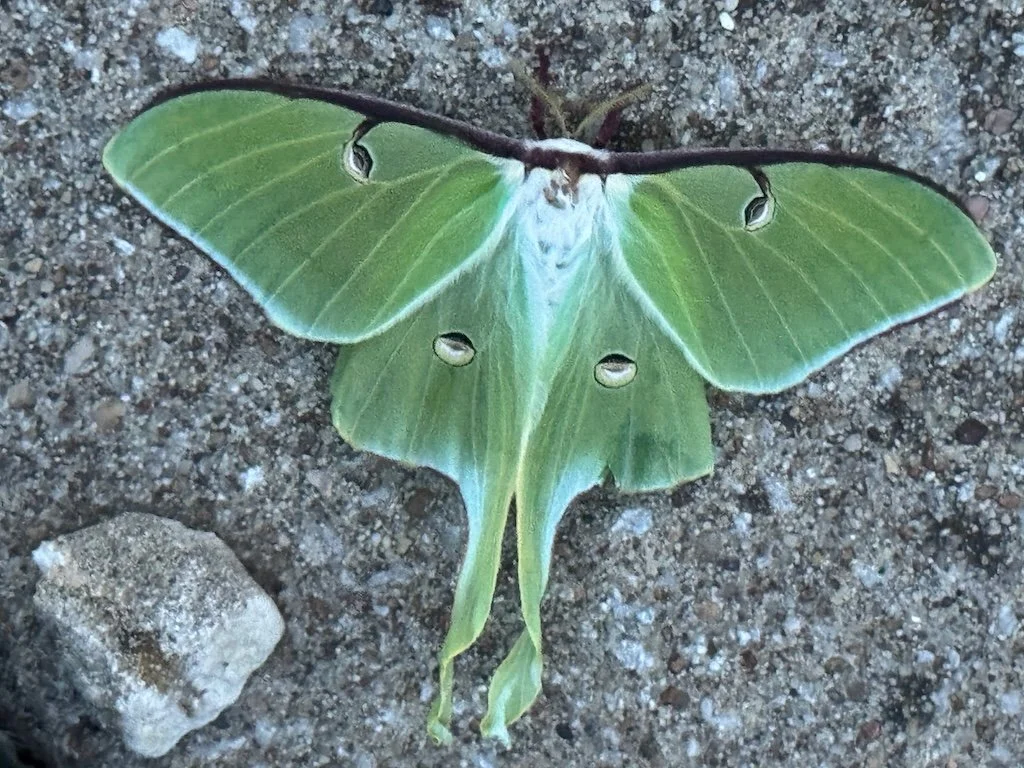
The Butterfly House has been my most substantial volunteering this summer…both in the house itself talking to visitors as they enjoy the butterflies and moths there and raising Luna moth caterpillars at home that have been taken to the house as big caterpillars and moths recently. The large cecropia caterpillars on display in the butterfly house recently were the 3 that were raised with my luna caterpillars (because they were mixed in when I was given the bin with a lot of newly hatched caterpillars). 

I’ve enjoyed all the volunteer gigs I’ve had this summer…even the ones that were outdoors on very hot days!

Gleanings of the Week Ending August 9, 2025

The items below were ‘the cream’ of the articles and websites I found this past week. Click on the light green text to look at the article.

Scientists unveil bioplastic that degrades at room temperature, and outperforms petroplastics – Sounds great…but will the existing plastic (made from petroleum) industry let this innovation move forward?

The world is getting hotter – this is what it is doing to our brains - As heatwaves become more intense with climate change, scientists are racing to understand how extreme heat changes the way our brains work. A range of neurological conditions are made worse by rising heat and humidity, including epilepsy, stroke, encephalitis, multiple sclerosis, migraine, along with several others. Heat can also alter other ways our brain functions – making us more violent, grumpy and depressed. Hospital admissions and mortality rates among people with dementia also increase during heatwaves. Rising temperatures have also been linked to an increase in stroke incidents and mortality. And there is a lot we do not know.

Bizarre New Creatures Discovered 30,000 Feet Under the Sea - Entire communities of animals, rooted in organisms that can derive energy not from sunlight but from chemical reactions. Through a process called chemosynthesis, deep-sea microbes can turn compounds like methane and hydrogen sulfide into organic compounds, including sugars, forming the base of the food chain.

Hawaiian Petroglyphs Reemerge for the First Time in Years - The full panel of petroglyphs has been exposed again after seasonal ocean swells swept away covering sand. In all, the petroglyphs are spread across 115 feet of beach and consist of 26 figures and abstract shapes that archaeologists believe were created 500 or more years ago.

The US Commercial Rooftop Solar Market Is About to Explode, Federal Tax Credits or Not - If all goes according to plan, all 500+ projects will be completed during this year into 2026, proving yet again that solar is the fastest way to add more capacity to the nation’s grid. Generating electricity on commercial rooftops and distributing it into the grid is America’s most shovel-ready energy option.

The Power of the Emerald Edge - Whether a tropical forest or coastal temperate rainforest, all forests must contend with a unique set of stressors including changes in land use, invasive insects and disease, and extreme weather events. Rapid changes in climate compound these stressors. How do we prepare our forests for the future? Preserving old-growth forests is one of the most powerful steps we can take.

Elusive and Majestic Red-Crowned Cranes in Hokkaido – Beautiful photographs…of beautiful birds.

Germany’s Stunning Fairytale Castles Added to UNESCO’s World Heritage List - The royal castles of Neuschwanstein, Linderhof, Schachen and Herrenchiemsee have been added to the prestigious list, which includes more than 1,200 sites. Neuschwanstein Castle, located near the village of Schwangau in Bavaria, is one of Germany’s most popular tourist sites. Every year, roughly 1.4 million travelers visit the site.

Learning how to live with shrubbier grasslands (part 1 and part 2) - Our grasslands are getting “shrubbier” and it’s increasingly difficult to prevent that. Because the drivers for that change are mostly beyond our control, it seems obvious that we need to start thinking differently about grassland management.

3 Ways Ancient Egypt Left Its Mark on Modern Art – Empire furniture, art deco, and artists like Bridget Riley.

Gleanings of the Week Ending August 2, 2025

The items below were ‘the cream’ of the articles and websites I found this past week. Click on the light green text to look at the article.

Introduction of Agriculture Didn't Immediately Alter Japanese Diets - Agriculture, rice, and millet were introduced to the Japanese islands from the Korean Peninsula around 3,000 years ago. Researchers recently examined plant residues on Final Jomon and Yayoi-period pottery from sites in northern Kyushu. The surprising results indicated that local culinary traditions changed very little after the crops were introduced to the island, as fish and seafood remained the primary foods.

Athens Is Reviving a 2,000-Year-Old Roman Aqueduct to Deliver Water to the City Amid Prolonged Droughts - If the Hadrian’s Aqueduct revitalization proves successful, it could become a model for other major cities experiencing water shortages. There are plans to expand in the other boroughs of Athens that the Hadrian Aqueduct runs through. But also, we have started a collaboration with another five or six cities in Europe that combine cultural heritage with water heritage to make more green, sustainable and livable cities.

Photography In the National Parks: Early Summer at White Sands National Park – Some good tips for photography when there is a lot of ‘white’ around! I remember trying in June of 2013 when I visited the place.

Teen bats are spawning new viruses—here’s why scientists are paying close attention - Juvenile bats frequently host multiple coronaviruses simultaneously—offering a real-time window into how new strains might arise. These findings, while involving non-human-infecting viruses, provide a powerful model to forecast how dangerous variants could eventually spill over into humans, especially as environmental pressures bring bats closer to human habitats.

Lentils Have More Protein Than Hamburger? - or a portion size of 100 grams, dry lentils have 23.6 grams of protein, with only 1.92 grams of fat. In case you are wondering, 100 grams is about 3.5 ounces. The amount of protein in “beef, ground, 80% lean meat” is 17.5 grams for the same portion size as the lentils! I’m going to look at some lentil recipes….add them into our meal plans.

A monumental 3,800-year-old warrior kurgan discovered in Azerbaijan - The burial chamber—2 meters wide, 6 meters long, and 3 meters deep—was divided into three symbolic sections: one for the human remains and weaponry, another for ceramic vessels, and a third intentionally left empty, possibly reflecting ritual beliefs about the soul’s journey in the afterlife.

China Breaks Ground on Colossal Dam Project in Asia’s Grand Canyon - A massive dam project in the Yarlung Tsangpo Grand Canyon in Tibet, the longest and deepest canyon in the world. Concerns are being raised about wildlife, electricity it produces being more expensive that comparable solar project, and the Chinese ability to withhold water or flood India in timed of conflict. The article did not discuss if there would be a risk for earthquakes as the weight of the water interacts with the geology of the canyon. Isn’t that area seismically active?

Arizona’s Declining Groundwater - For more than two decades, NASA satellites have peered beneath the surface and measured changes in the groundwater supplies of the Colorado River Basin. Based on these measurements, researchers report rapid and accelerating losses of groundwater in the basin’s underground aquifers between 2002 and 2024. About 68 percent of the losses occurred in the lower part of the basin, which lies mostly in Arizona. Irrigated agriculture consumes about 72 percent of Arizona’s available water supply; cities and industry account for 22 percent and 6 percent.

Mineral v chemical sunscreen: Which one should you be using? - UV exposure can lead to skin cancer, the most common type of cancer in countries including the US and the UK. If it spreads, the deadliest type, melanoma, has only a 35% five-year survival rate. The best sunscreen, experts say, is one you are happy to use!

Meet the Tuatara: New Zealand’s Bizarre Ancient Reptile - While the tuatara is related to snakes and lizards, the two reptilian groups diverged about 250 million years ago. That’s a long time in evolutionary terms. For context, humans are more closely related to kangaroos than tuatara are to lizards.

Gleanings of the Week Ending July 26, 2025

The items below were ‘the cream’ of the articles and websites I found this past week. Click on the light green text to look at the article.

Greenland Sled Dog DNA Reveals a Story of Human Migration and Ancestry of the Unique Breed - The ancestors of the Inuit arrived in Greenland earlier than previously thought—potentially even before the arrival of the Vikings.

A Bird’s Eye View: Drones Search for Grassland Birds in Colorado - Drones have been used to survey animals from afar for years; this project borrows from those learnings for the novel —and challenging—task of detecting small-bodied, ground-nesting birds (Bobolinks) amid thick, tall grass, without disturbing the species of interest.

Hungary's oldest library is fighting to save 100,000 books from a beetle infestation - Tens of thousands of centuries-old books are being pulled from the shelves of a medieval abbey in Hungary to save them from a beetle infestation that could wipe out centuries of history. I wondered how many of the books have been scanned.

'Wobbly-tooth puberty': How children's brains change at six-years-old – A stage in which a child is constructing their identity, and they're trying to figure out who they are in relation to other people. The transformation includes a greater capacity to reflect on their feelings and modify them when needed, along with an "advanced theory of mind" that allows them to think more sophisticatedly about others' behaviors and respond appropriately. They also begin master the basics of rational enquiry and logical deduction, so that they can take more responsibility for their actions

How a hidden brain circuit fuels fibromyalgia, migraines, and PTSD - Scientists at the Salk Institute have discovered a hidden brain circuit that gives pain its emotional punch—essentially transforming ordinary discomfort into lasting misery. This breakthrough sheds light on why some people suffer more intensely than others from conditions like fibromyalgia, migraines, and PTSD. By identifying the exact group of neurons that link physical pain to emotional suffering, the researchers may have found a new target for treating chronic pain—without relying on addictive medications.

Greenland’s Bejeweled Ice Sheet - In spring 2025, jewel-toned points of blue began to appear on the white surface of the Greenland Ice Sheet. As summer arrived, they grew larger and more numerous, taking on unique shapes and occasionally forming connections. The colorful seasonal phenomenon is due to meltwater from snow and ice, which pools atop the ice sheet in places each melt season. An image from the Operational Land Imager-2 on NASA’s Landsat9.

Easter Island Was Far Less Isolated Than Previously Believed, Study Reveals - Earlier genetic studies in the 2010s laid the ground for the most recent investigation, showing that Easter Island was reached at least two times by the 14th century. Further influence arrived from pre-European South Americans, an interaction evidenced by the presence of sweet potatoes and the Birdman concept. This post is about the idea that after language, plants, animals, and material culture arrived on Easter Island from the west, monumental ritual architecture began traveling in the opposite direction.

In a First, Solar Was Europe’s Biggest Source of Power Last Month - Solar was the largest source of electricity in the EU in June, supplying a record 22 percent of the bloc’s power. Solar amounted to more than 40 percent of generation in the Netherlands and 35 percent in Greece. Analysts say that the June surge in solar power helped Europe weather a brutal heat wave, which saw temperatures soar upwards of 110 degrees F (43 degrees C). Last month was the warmest June on record in Europe, and scientists say that climate change played a key role in the heat wave, pushing temperatures to dangerous extremes.

Inequality has risen from 1970 to Trump − that has 3 hidden costs that undermine democracy – A thought provoking post. The author described 3 ways that the increase in inequality undermines democracy: 1. Fraying social bonds and livelihoods, 2. Increasing corruption in politics, 3. Undermining belief in the common good.

Honeybees remove 80% of pollen—leaving native bees with nothing - Our modern agricultural industry is so reliant on honeybees that humans have introduced them worldwide, and in many cases, they have escaped human management and risen to prominence in natural ecosystems as non-native, feral populations. And, like any other non-native organism, feral honeybees may perturb native ecosystems when they become sufficiently abundant.

Gleanings of the Week Ending July 19, 2025

The items below were ‘the cream’ of the articles and websites I found this past week. Click on the light green text to look at the article.

Doctors say we’ve been misled about weight and health - Doctors' advice about healthy eating and physical activity is still relevant as it may result in better health. The main goal is to offer good care irrespective of weight, which means not caring less but rather discussing benefits, harms, and what is important to the patient.

Let’s Consider a Couple of Workable Solutions to the Plastic Crisis – The first is to reduce the reliance on plastic shopping bags. Research shows that plastic bags were much less frequently found in beach litter where communities had implemented plastic bag policies. The second is green roofs in cities. Green roofs were shown to be more than capable of intercepting microplastics — at the rate of 97.5% efficiency for trapping microplastics from atmospheric deposition…..and roof areas make up 40-50% of urban impermeable areas.

Melting Glaciers Will Lead to More Volcanic Eruptions – New research from the Chilean Patagonia. Glaciers tend to suppress the volume of eruptions from the volcanoes beneath them. But as glaciers retreat due to climate change, the findings suggest these volcanoes go on to erupt more frequently and more explosively. According to a 2020 study, 245 of the world’s active volcanoes are within three miles of ice. 

A Partnership for a Healthier Appalachian Forest - The story of the southern Appalachians – and many forests across the United States – is one of widespread logging between the early 1900s and 1940s. That was followed by the “Smokey Bear era” of fire suppression. Now active management is the strategy including thinning, herbicide application and controlled burns.

The Vienna cemetery where endangered species and biodiversity thrive – 2.4 sq km (0.9 sq miles). The cemetery is home to European hamsters, Europea green toad, Alpine longhorn beetle, European ground squirrel, and Eurasian hoopee….and many other species.

Photos: Before-and-after satellite images show extent of Texas flooding destruction – It’s hard to fathom the scope of the destruction...and how fast the water rose in the darkness.

Florida Seniors Face Rising Homelessness Risk - Florida seniors make up a growing portion of the state’s unhoused population as the housing crisis continues. Cost of housing is increasing with institutional investors buying up land and insurance costs skyrocketing.

Researchers Unearth 3,500-Year Old Peruvian City with an Illustrious History - Probably a market hub, and that once connected Pacific coast communities with those in the Andes and Amazon thriving around the same time as early Middle Eastern and Asian civilizations. The urban center is known as Peñico and was founded between 1,800 and 1,500 B.C., experts said. It is near the location where the Caral civilization, said to be the oldest in the Americas first appeared 5,000 years ago. Following eight years of research, the experts classified as many as 18 structures including ceremonial temples and residential housing complexes. Sculptural reliefs and works showing the pututu, a conch shell trumpet can also be seen on some of the walls. Researchers also found clay sculptures of human and animal figures, as well as necklaces created with beads and seashells.

Emily Sargent’s Long-Hidden Watercolors Debut at the Met – John Singer Sargent’s younger sister watercolor paintings. They were lost for decades, until some of her relatives found a forgotten trunk in storage containing hundreds of her paintings.

Blast From the Past: Arizona’s Meteor Crater - Meteor Crater (also called Barringer Meteor Crater) is located between Flagstaff and Winslow on the Colorado Plateau as seen by the Operation Land Imager (OLI) on Landsat 8. I’ve seen it from the ground!

Yard Work – June 2025

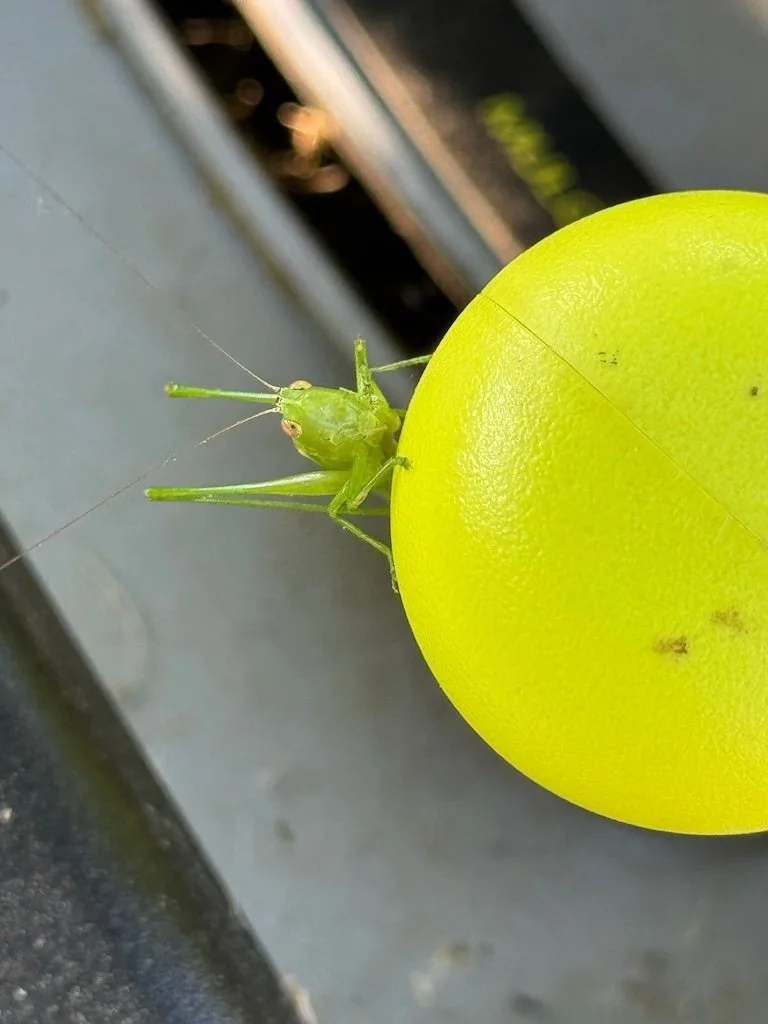
It’s the time of year when there is a lot to do in the yard. There is always something to see along the way….like an insect on one of lawn mower knobs. I am appreciating the new blades my husband installed on the mower.  It does not clog as easily when the grass is a little wet and the batteries seem to last longer too.

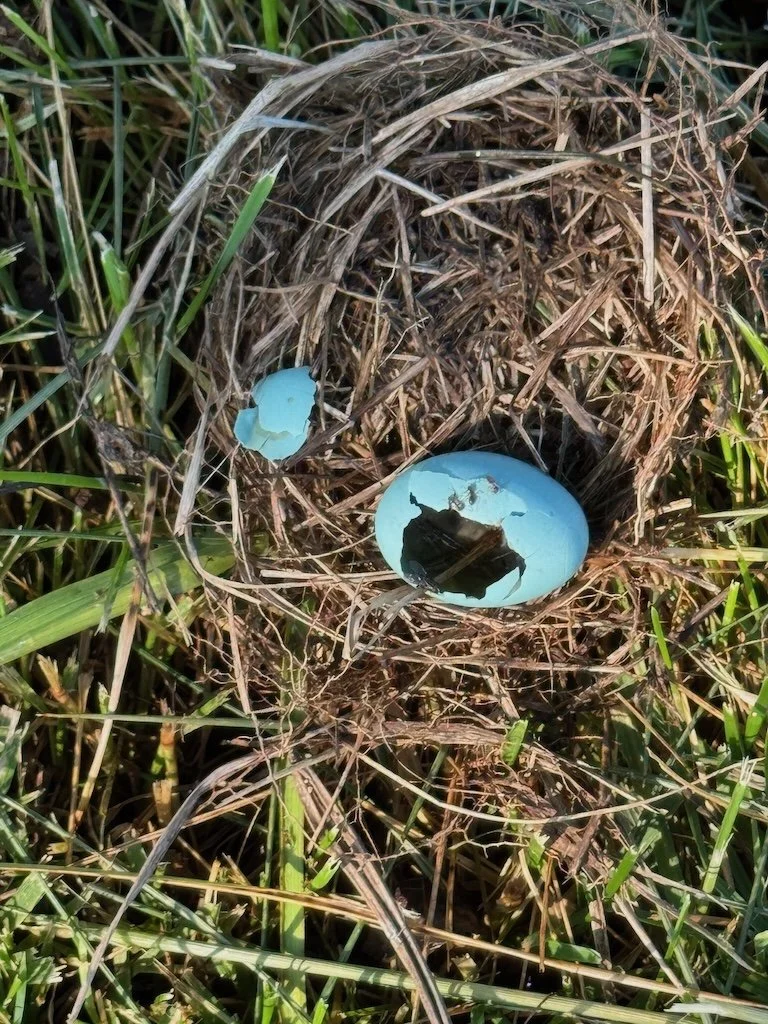
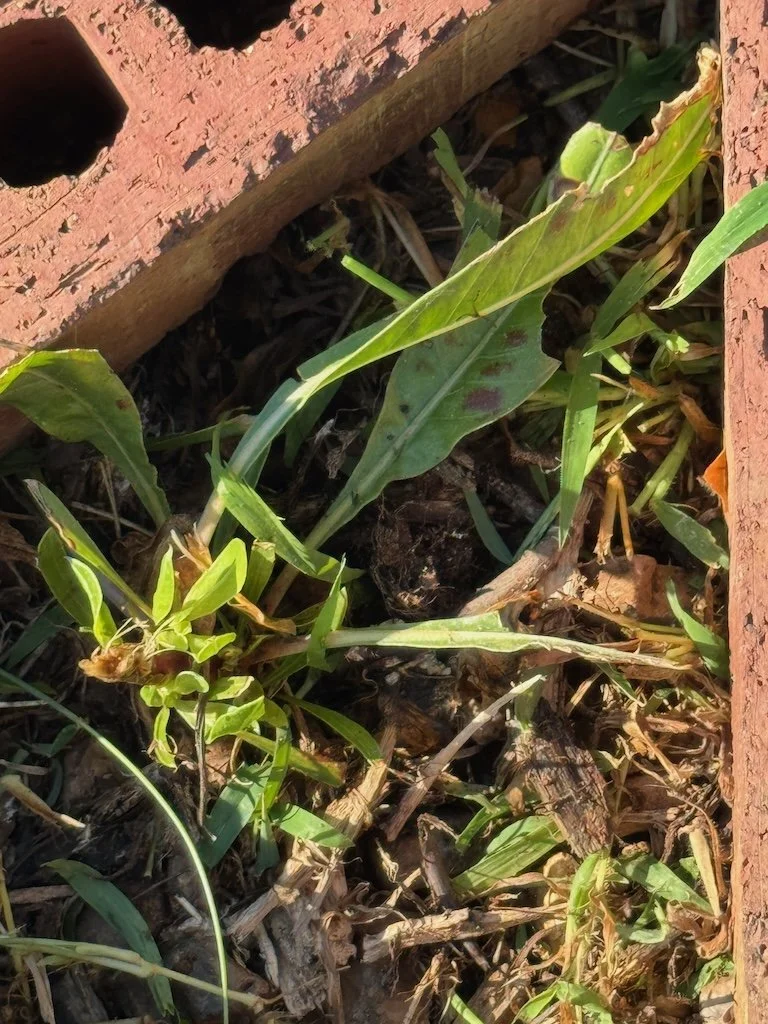
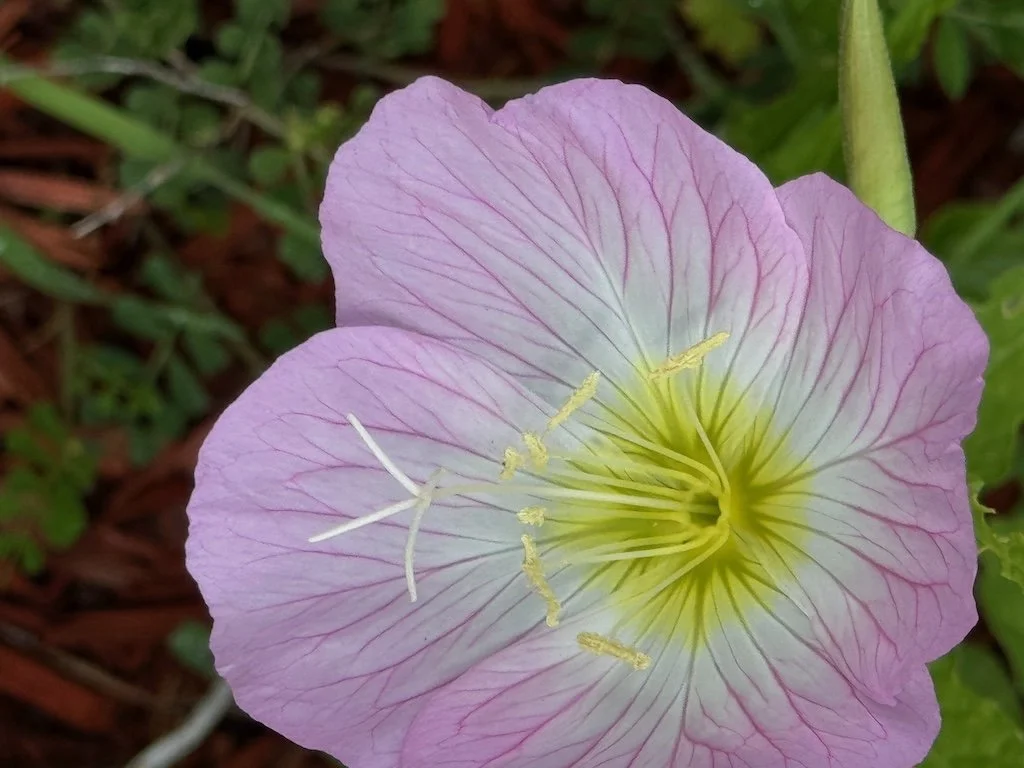
With my husband’s surgery in May, we got a little behind on edging and weed eating. When he was recovered enough to do the edging, he went out to check the situation and someone in the neighborhood had already done it! They also did some weed eating which was not as appreciated since they cut some daylilies and my Missouri evening primrose too. There was a smashed bird nest/egg nearby as well (although that could have been from another cause). I put some bricks around the cut primrose and later pulled most of the grass growing around it. I posted a thank you with a proviso about the evening primrose and day lilies on the neighborhood’s Facebook page since I have no idea who did it.

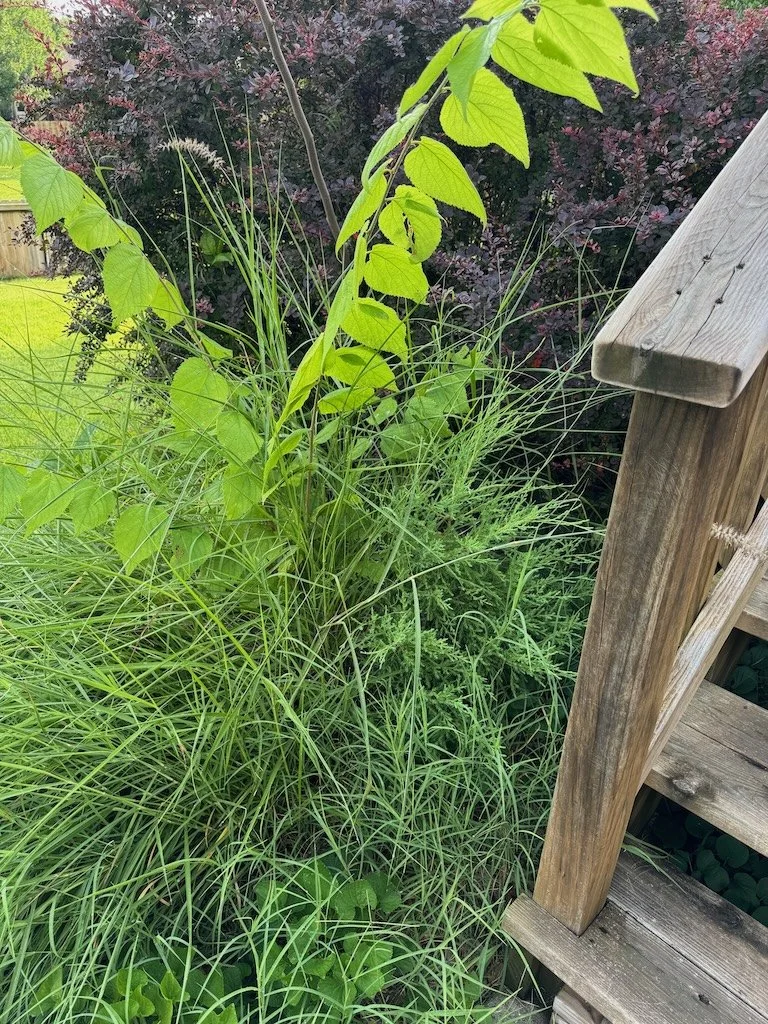
We have hackberries coming up everywhere….planted by birds. There is a large hackberry near the neighborhood pond – probably the parent. I am cutting them at this point but might leave one if it comes up in a place that it could grow to be a tree. Poke weed and Virginia Creeper are other natives that are prolific in the yard…..sometimes a little overwhelming and I usually leave them – particularly in the back yard. Poison ivy is something I always try to pull as soon as I find.


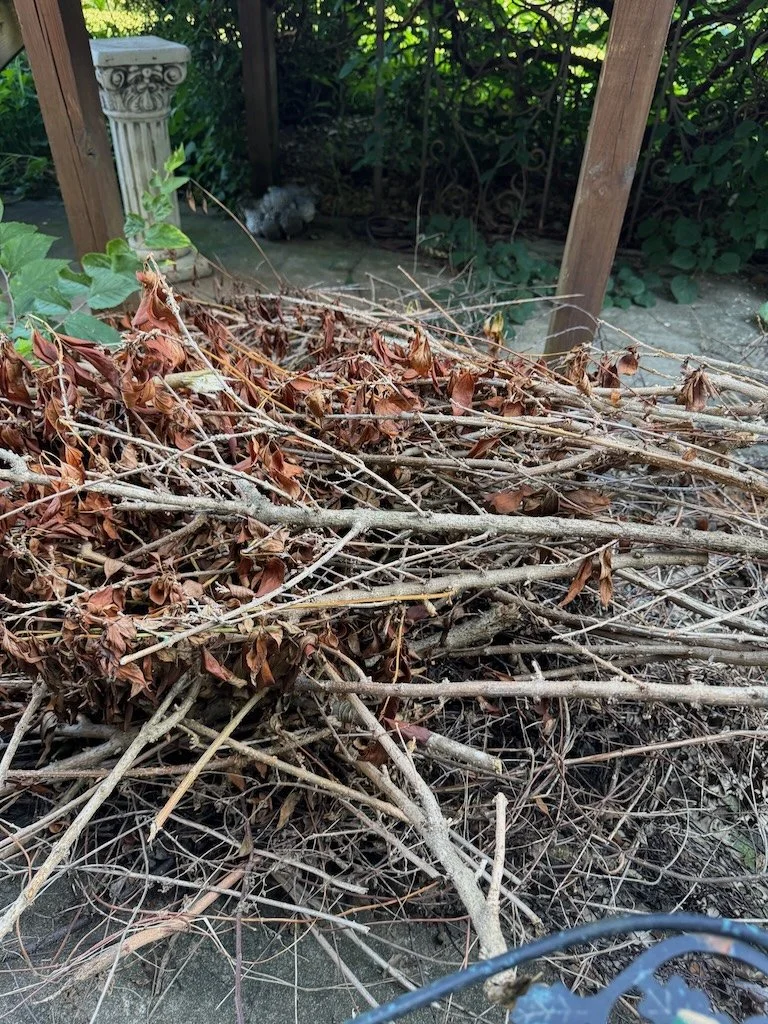
A hedge parsley came up in one of my flower beds…and it was pulled since it is not native to North America and tends to spread. I do the same with tree and Asian honeysuckle. A forsythia (also non-native) has been an ongoing project in my back yard. I am gradually cutting it down and will eventually paint the cut stubs with herbicide to kill it. I would rather have a native bush there. In the meantime, the results of my pruning are making a higher pile on my deck….drying out now and will be burned in the fall in my chimenea.

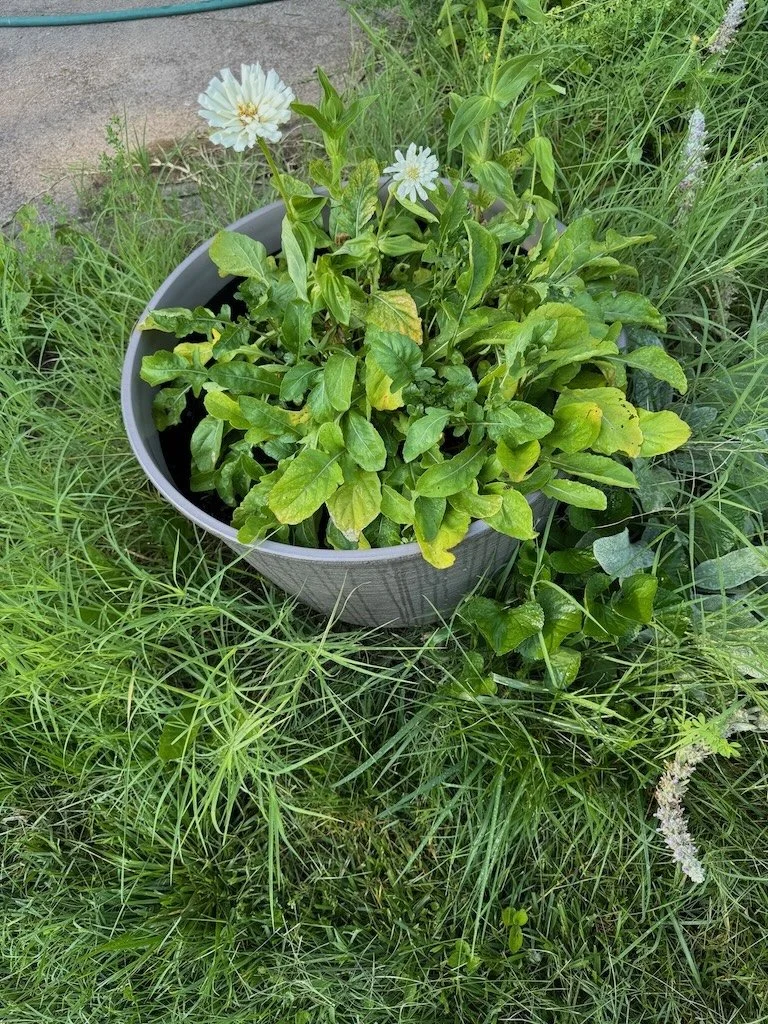
I planted a pot of flowers and veggies and a white oak seedling in late May. The zinnias are beginning to bloom! I won’t do it long term since it must be watered frequently….not something I want to do! I’ll have to decide where to put the white oak.

Other than my mower - my pruners, water bottle and gauntlet gloves are my primary tools. I’ve purchased some summer weight sunblock shirts and wear a hat, so I don’t need sunscreen except on my face!

Gleanings of the Week Ending July 12, 2025

The items below were ‘the cream’ of the articles and websites I found this past week. Click on the light green text to look at the article.

How Has U.S. Energy Use Changed Since 1776? – Historical perspective. Coal, petroleum and natural gas did not surpass renewables (i.e. wood) until 1885!

Is this the end for Easter Island's moai statues? – The moai are made from tuff, a volcanic rock largely composed of compressed ash. This type of stone is porous and unusually soft. The wind and rain do not treat it kindly. Weathering of the moai appears to have increased sharply during recent decades; drier weather followed by very heavy rains, more wildfires, rising sea level  and increased wave event have all contributed.

20 Incredible Nominees for the BigPicture Natural World People’s Choice Award – Some great photography.

In Yellowstone, Even Animals Sometimes Make Mistakes – A bison stumbled into Grand Prismatic Spring…and there was no happy ending.

London Inches Closer to Running Transit System Entirely on Renewable Power - London will source enough solar power to run its light railway and tram networks entirely on renewable energy. The deal brings Transport for London closer to its goal of running its entire transit system, including its sprawling underground railway network, on renewable energy by the end of this decade.

Time For Canada to Dump the Big Three & Go Electric with China – Something valid for Canada to consider…certainly more forward looking than subsidizing old technologies.

The end of tuberculosis that wasn’t - In the late 1980s, many thought the fight against tuberculosis (TB) had been won. A disease that had plagued humans for at least 9000 years was on the path to being eliminated. Three factors raised concerns about the resurgence of tuberculosis in the United States and rich countries in Europe in from mid-1980s and 1990s: HIV/AIDS epidemic, the rise in drug-resistant tuberculosis, and higher rates of TB in foreign-born populations.

The US’s asbestos U-turn: why the Environmental Protection Agency is reconsidering its ban - Each year, around 40,000 deaths in the US and about 5,000 in the UK are attributed to asbestos exposure. If the US ban is lifted, it’s possible that the number in the US could increase over the coming decades while those in the UK will continue to fall. While global consensus moves toward stricter regulation, the US now finds itself at a crossroads, between scientific evidence and pressure from industry.

Inside Egypt’s Enigmatic $1 Billion Grand Museum - During a press conference on June 14, Egyptian Prime Minister Mostafa Madbouly said the official opening was postponed due to “current regional developments”—loosely referring to the then-escalating conflict between Israel and Iran.

These Colorful Satellite Views Reveal Our Forests in Unprecedented Detail and Showcase the Potential of the New Biomass Mission - The European Space Agency’s satellite will measure trunks, branches and stems in forests to shed light on how much carbon is stored in trees across various continents. The example image of the Beni River in Bolivia shows a lot of oxbow lakes!

Gleanings of the Week Ending July 5, 2025

The items below were ‘the cream’ of the articles and websites I found this past week. Click on the light green text to look at the article.

See the Face of a 10,500-Year-Old Woman, Reconstructed by Archaeologists and Artists – Based on well-preserved ancient DNA.

Rare, Mind-Bending M.C. Escher Works Are Up for Auction - Escher was a skilled artist who seamlessly bridged the worlds of art, mathematics, and science in the mid-20th century. Today, his influence remains as important as ever, with a fascinating body of work that continues to mesmerize and inspire minds across the world.

As Wind and Solar Grow, China Ships More Coal Overseas - Analysts say the era of “more renewables, more coal” in China is over, with solar and wind now set to displace coal, rather than supplement it. Even under conservative assumptions coal generation in China could soon peak and enter structural decline.

Work, wages and apprenticeships: sifting for clues about the lives of girls in ancient Egypt - Elephantine, a town at Egypt’s southern frontier near modern-day Aswan, provides a unique window into the urban life of some girls who worked in textile workshops during the ancient Egyptian Middle Kingdom, which dates approximately 2030–1650 BCE. Girls received payment for their labor. It also suggests a structured apprenticeship system where young girls (and boys) worked alongside experienced craftswomen. Historians must always look beyond elite contexts to incorporate diverse evidence types – administrative documents, archaeological remains, and artistic representations – to construct a more complete picture of ancient lives.

Earth’s Clouds on the Move - Clouds are common on Earth, but they are ephemeral and challenging to study. Remote sensing has helped scientists tremendously by enabling consistent, global tracking of the elusive features, even over inaccessible areas like the poles and open ocean. Two published studies: 1) Where storm clouds form has changed. The implications for the climate are significant: This has added a large amount of warming to the system. 2) The shift in storm clouds increased the amount of energy absorbed by the oceans by about 0.37 watts per square meter per decade—a substantial amount on a planetary scale. Big question: What has caused the reduction in reflective storm clouds and whether the trend will continue.

Sinkhole Exposes Remnants of Medieval English Hospital - Walls hidden just beneath the city streets that once belonged to the twelfth- or thirteenth-century St. Leonard’s Hospital. The institution was built just after the Norman conquest and replaced the earlier St. Peter’s Hospital, which was founded by the Anglo-Saxon King Aethelstan. It was a place for caring for the unwell, elderly, and the condemned, but also served as an orphanage, helped feed the poor, and provided meals for the prisoners in York Castle. The hospital was destroyed during the Reformation under the reign of Henry VIII.

Lightning Strikes the Arctic: What Will It Mean for the Far North - A warmer world is expected to bring more thunderstorms, especially at higher latitudes. Scientists are now reporting a dramatic surge in lightning in the Far North and are scrambling to parse how this could affect wildfires, the chemistry of the atmosphere, and Arctic ecosystems.

Scavenger Animals Are in Trouble, and That Could Spell Bad News for Human Health - Scavengers are in trouble—and their decline could be harmful to human health. Half of the 17 obligate scavenger species included in the study are considered “vulnerable” or “critically endangered” by the IUCN. When they are reduced in numbers or disappear, some smaller, occasional scavengers are proliferating. These creatures, such as rodents and feral dogs, tend to transmit diseases to humans.

How do sleep trackers work, and are they worth it? A sleep scientist breaks it down - Most modern sleep trackers do a decent job of estimating your total sleep each night. Some are more accurate for sleep staging, but this level of detail isn’t essential for improving the basics of your sleep. Focus on improving your healthy sleep strategies and pay attention to how you feel during the day.

Is an apple a day really good for your health? - Eating an apple a day is great– but only if that is part of a diet rich in various other plant-based foods, since that is a key driver of good health.

Volunteering at the Library

I helped set up the used book sale at one of our county libraries last Friday. It was different than last year because the room was in use until 5 PM so our set up was delayed until after that. In addition, it was raining all afternoon. I wondered if there were going to be a lot of wet boxes.

I got there about 10 minutes before the allotted time and there were indeed people in the room, so I worked on a jigsaw puzzle that the library had set up near a window while I waited. Other volunteers were arriving too – some with a load of book boxes in their cars (since it was raining – enclosed vehicles were required…the usual pickups could not be used).

After helping stack chairs and move tables to the periphery of the room, I got started on the children’s books like what I did last year. There was a table and a cart. The differences from last year were 1) more helpers and 2) less books (we estimated what we needed for the sale based on what happened last year). I had two helpers that loaded the bottom shelf of the cart, so I didn’t have any backache from this set up! We were done in less than an hour.

Gleanings of the Week Ending June 28, 2025

The items below were ‘the cream’ of the articles and websites I found this past week. Click on the light green text to look at the article.

Meet the Kangaroos That Live in Trees - Filling an evolutionary niche akin to monkeys, they’re keystone species in the rainforests of New Guinea and Australia.

Manet Cut This Painting in Half 150 Years Ago. Now, the Two Sides Are Back Together for a Rare Reunion - In 1874, Manet began to paint a scene of the Brasserie Reichshoffen on a large canvas. Unlike his paintings of military scenes or upper-class life of the 1860s, the new piece captured the dramas of everyday life. But Manet became dissatisfied with the composition of the large work and opted to cut the canvas in two. Over the next few years, he refined each half into more concise, if slightly less ambitious, depictions of the same café: At the Café and Corner of a Café-Concert. While both paintings are well regarded, Manet’s contemporaries struggled to understand his decision to separate them. But Manet’s conviction that the two should be kept apart remained strong. When the two paintings of the same café were exhibited at the Triennial Salon in Antwerp in 1879, they were shown in separate rooms.

Deconstructing Buildings: The Quest for New Life for Old Wood - A growing number of cities have launched initiatives to reuse the wood waste from construction and demolition that now ends up in landfills. The challenge, proponents say, is to deploy new techniques for disassembling old buildings and markets for repurposing the salvaged wood. Using reclaimed wood in buildings stores carbon and helps reduce emissions by avoiding the need to cut new trees. Going forward, some architects say, buildings should be designed for disassembly — meaning every structure is built not only to last but also for easy dismantling and repurposing when its time is up.

Why the appendix is much more important than we once thought - The appendix has been shown to be an important component of immune function, especially in early life. In addition, the appendix itself contains a very diverse and varied microbiota distinct from other parts of the gastrointestinal tract, suggesting a specialized role. Removal of the appendix has been associated with a reduction in gut bacterial diversity which can lead to intestinal dysbiosis and potentially increase susceptibility to various diseases. Appendectomy has also been linked to an increase in fungal diversity in the gut; the appendix may play a role in the balance between bacterial and fungal populations, potentially acting as a store of commensal gut microbiota that repopulate the colon after exposure to pathogens or antibiotic treatment. The appendix may play a further role in protecting the gastrointestinal system from invading pathogens.

How Extreme Heat Impacts Children - Infants and young children sweat less and are unable to regulate their core body temperature as well as adults. Playgrounds are not always built with materials designed to withstand heat and prevent burns. Older children such as high school athletes face increased risk of heatstroke and other illnesses during practices and games. 

Weather makers: How microbes living in the clouds affect our lives - Trillions of bacteria, fungi, viruses and single-celled organisms travel the globe high in the atmosphere. Current aerobiologists deploy sophisticated air-samplers on drones and use DNA-sequencing technology to identify airborne life by its genes. The aerobiome, researchers now recognize, is an enormous habitat filled only with visitors. By one estimate about a trillion trillion bacterial cells rise each year from the land and sea into the sky. By another estimate, 50 million tons of fungal spores become airborne in that same time. Untold numbers of viruses, lichen, algae and other microscopic life forms also rise into the air. It's common for them to travel for days before landing, in which time they can soar for hundreds or thousands of miles. The aerobiome is a force to be reckoned with – one that exerts a powerful influence on the chemistry of the atmosphere. It even alters the weather. It turns out that biological molecules and cell walls are exceptionally good at triggering rain. More sobering… In a 2023 survey of clouds, bacteria carrying 29 different kinds of resistance genes were found.  A single airborne bacterium may carry as many as nine resistance genes, each providing a different defense against drugs. Every cubic meter of cloud could hold up to 10,000 resistance genes. A typical cloud floating overhead may hold more than a trillion of them.

The New Normal Is Already a Loss: How Shifting Baselines Skew Our View of Nature - Think back on the bird song you woke up to this morning. You might have pulled out a few recognizable threads, perhaps the robin, the crow, the sparrow. Now imagine what morning might have sounded like to your grandparents. Major scientific studies indicate that it was likely a cacophony of song by comparison—many kinds of birds and more of them. The difference, the shift in normal, is gradual over time and the loss, without memory or data, is hard to define. With each generation, our perception of the natural world changes, and with it, our understanding of what accounts for abundance and loss of biodiversity. A term bandied about is the “new normal.” In ecology, it’s called the shifting baseline syndrome. 

Fungi to the Rescue: How Mushrooms Are Helping Clean Up Toxic Lands - Mycoremediation, the use of fungi to break down pollutants and absorb heavy metals from contaminated soil. Certain species can transform petrochemicals, pesticides, and heavy metals into harmless compounds or concentrate them for safer removal. This nature-based method offers an affordable, less disruptive alternative to traditional “dig and dump” remediation approaches.

A History of Some National Park Roads – The only roads mentioned in the article I haven’t experienced is Generals Highway in California and Going-to-the-Sun Road in Montana!

The Famous, Feathered Dinosaur Archaeopteryx Could Fly, Suggests New Study of a ‘Beautifully Preserved’ Fossil - A fossil collector discovered the Chicago Archaeopteryx sometime before 1990 in limestone deposits near Solnhofen, Germany, where all known Archaeopteryx fossils originate. As the Field Museum’s preparators worked on the pigeon-sized Chicago Archaeopteryx, they realized that the fossil included more soft tissues and delicate skeletal details than any other known Archaeopteryx specimen. From previous fossils, they already knew the dinosaur had asymmetric feathers, which are vital to creating thrust in modern, flying birds. But the hard slab of limestone around this specimen had also preserved a key layer of feathers called tertials that had never been documented before in Archaeopteryx.