Gleanings of the Week Ending March 28, 2026

The items below were ‘the cream’ of the articles and websites I found this past week. Click on the light green text to look at the article.

3/23/2026 Washington Post What an oncologist wants you to know about environmental cancer risks - Given what we know about how microplastics can cause damage in the body, the increase in early onset colorectal cancer in the U.S. and the similarities in timing between the increase in cancer rates and the rapid increase in microplastics in the environment, many experts suspect that microplastics are a risk.

3/14/2026 BBC The strange deep-sea creatures that eat whales - Whales usually die far out to sea, scattered along their often vast migration paths. t first, the carcass may float as the gases inside make it swell up like a balloon. Then the whale sinks – through the sunlight, twilight and midnight zones – eventually reaching the darkness of the abyss, its final resting place. In death, the whale gives life, becoming an immense island of food.

3/16/2026 MSN Couples with infertility 'detox' from plastic to get pregnant in new Netflix doc. Does it work? - A new Netflix documentary called "The Plastic Detox" is a sobering look at all the ways that plastic harms our bodies and the planet — especially our reproductive health. Shanna Swan, Ph.D., a professor at Mount Sinai in New York City, is one of the prominent figures sounding the alarm on the effects of environmental pollutants on fertility. For the documentary, she worked with five couples who'd been struggling to get pregnant for years without a medical explanation. The goal? To reduce their exposure to plastics to see if they could conceive. In the end of the documentary, it's revealed three of the couples had gotten pregnant, and one was expecting again. The results were also published in a study in the journal Toxins on March 16.

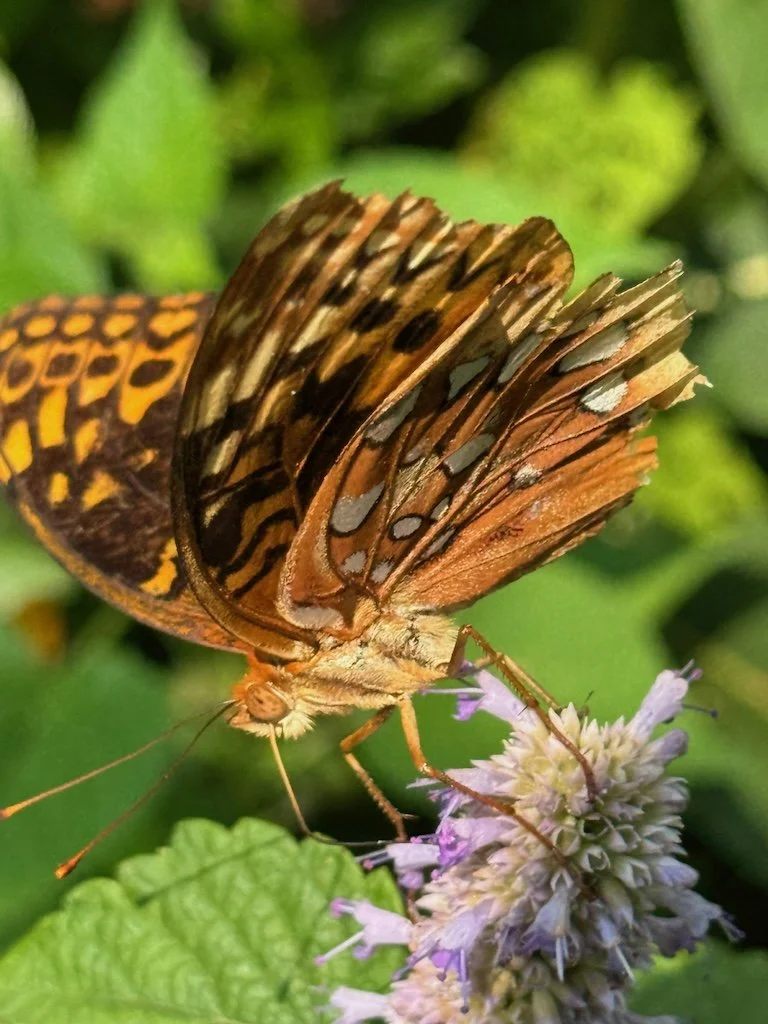
3/20/2026 Yale Environment 360 In Mexican Forests, Monarch Butterflies Halt Their Decline - For the past quarter century, the future of monarch butterflies has looked dire, with these iconic American insects flitting toward extinction. Now, however, there is at least a small reason for hope: New data from WWF Mexico, a large conservation group, offers further evidence that the decline of eastern monarchs — the world’s largest population — has stopped, even as the insects face worsening threats across their range.

3/16/2026 Our World in Data Why cheap waste management is key to stopping plastic pollution – I was disappointed in this article. They completely miss the issue of food packaged and heated in plastic. Yes – that plastic packaging does not get loose in the environment but the microplastics (and chemicals) that leach into food gets into our bodies. And the leachate coming off lined landfills in countries with good waste management systems includes microplastics that the sewage treatment plants don’t take out before the liquid is released back into streams….and that will continue to happen for many years to come. And what happens when the liners of the landfills begin to break down and the leachate goes more directly into the environment. The answer in probably not cheap waste management…we need to be look at less waste – particularly less plastic waste.

2/17/2026 NASA Winds Whip Up Fires and Dust on the Southern Plains – This satellite image is from mid-February but I noticed smoke in the air as I drove on I-44 east of Tulsa last weekend! I don’t know if it was wildfires or controlled burns…but I was glad I had a portable air purifier in my car!

3/21/2026 I’m Plastic Free 9 Essential Ways to Reduce Plastic Waste on Your 2026 Travels – I would add a reusable bowl/plate for hotel breakfasts (along with cutlery…I take stainless steel cutlery since I have an extra set…and simply clean then to reuse…I have a tin that keeps them together).

3/18/2026 Smithsonian Magazine Cannibalistic Blue Crabs Are Eating Their Younger Peers in Part of the Chesapeake Bay - Young blue crabs find refuge from many predators in the mid-salinity waters of some spots along the Chesapeake Bay. But there, they face another threat: Getting eaten by their older peers.

3/16/2026 National Parks Traveler What It Takes to Clean a Yellowstone Hot Spring - Cleaning hot springs is hard work! Some remediations, like the Grand Prismatic Overlook trail spring, require shovels, strainers, and grabber tools. The cleaning of Solitary Geyser, however, required a hook with a 16-foot extendable handle to remove large objects within the interior parts of the pool and hand rakes to collect the hundreds of wood splinters that had been thrown into the splash basins around the pool margin.

3/13/2026 Science Daily Microplastics may be quietly damaging your brain and fueling Alzheimer’s and Parkinson’s - Researchers identified five key biological pathways that may allow microplastics to harm the brain. These include activating immune cells, increasing oxidative stress, disrupting the blood-brain barrier, interfering with mitochondria, and damaging neurons. The review also describes how microplastics might contribute to specific neurodegenerative diseases. In Alzheimer's disease, they may promote the buildup of beta-amyloid and tau proteins. In Parkinson's disease, they could encourage aggregation of α-Synuclein and harm dopaminergic neurons. Additional studies are needed to confirm a direct causal link. Even so, the researchers recommend practical steps to reduce everyday exposure. We need to change our habits and use less plastic. Steer clear of plastic containers and plastic cutting boards, don't use the dryer, choose natural fibers instead of synthetic ones and eat less processed and packaged foods.

Gleanings of the Week Ending July 9, 2022

The items below were ‘the cream’ of the articles and websites I found this past week. Click on the light green text to look at the article.

Bonsai trees tell of winters past – An elfin forest of hemlocks on the outer coast of Glacier Bay National Park…and they hold the history of 4 centuries of winters in their growth rings.

See the vibrant, long overlooked colors of classical sculptures – Greco-Roman marble sculptures were covered in bright hues (polychromy) originally!

Pioneering recycling turns mixed waste into premium plastics with no climate impact – Wouldn’t it be great if suddenly mixed waste could replace fossil raw materials for ALL plastic production?

Understanding horseshoe crabs at Cape Cod National Seashore – A short video about a research project just starting.

Get a Sneak Preview of the 2022 Bird Photographer of the Year Finalists – Capturing birds in action…rather than portraits.

Invasive species taking over some American forests - Amur honeysuckle (a shrub from Asia) is a big culprit. Callery Pear (the ‘wild’ version of the Bradford pear) is a close second.  I just cut down a Callery Pear that was growing in the front bed of my new house in Missouri…almost obliterating a crepe myrtle! Other foreign species that have become problematic: porcelain berry, tree of heaven, winged euonymus, European buckthorn, Oriental bittersweet, common privet and lesser periwinkle...Norway maple, Amur cork tree and white poplar along with herbaceous species such as lesser celandine, garlic mustard, Japanese knotweed and Japanese stilt grass.

A Surprisingly High Number of Wildfires Are Caused by Electrocuted Birds – Awful….good that there is a way to reduce the carnage…at less cost than the consequences of the fires.

Rural areas near coast will bear the brunt of US sea-level rise – Analysis focused on the Chesapeake Bay…marshes forming where forest and farmland is today.

Once-Common California Bumble Bees Have Gone Missing – The survey did not find the formerly abundant Western bumble bee. The last statewide survey was conducted 40 years go…and a lot has happened in that time: habitat loss, pesticides, and climate change. None of the species were doing well. Big problem – since bumble bees help pollinate $3 billion worth of crops in the US each year (including tomatoes, peppers, and cranberries).

Scientist war of links between soil pollution and heart disease – The author of the study commented: “Until we know more, it seems sensible to wear a face mask to limit exposure to windblown dust, filter water to remove contaminants, and buy food grown in healthy soil."

Road Trip to the Eastern Shore

2002 01 IMG_7292.jpg

My husband and I signed up for the field trips offered by Delmarva Birding the last weekend of January. The first one was on Friday afternoon, so we finished packing and left after the morning rush hour. I was still up early enough to see the sunrise. There were enough clouds to hold the light.

The clouds had thickened by the time we left. By the time we got to the Bay Bridge, the water and sky were very gray. The bridge going from east to west is being renovated…I took a picture as we crossed the other span….intending to take more on the way home.

2002 01 IMG_7305.jpg

Our first ‘birding’ happened on the road. As we drove near Bridgeville, Delaware - a flock of snow geese flew up from a field. I took a picture as we drove past. That field was the only one we saw with a flock of birds like that. Maybe more grain had been spilled in that field?

2002 01 IMG_7306.jpg
20200126_133546.jpg

The Sunday afternoon, as we were driving back, was cloudy again. The view of the part of the bridge under active construction showed a lot of barriers to catch debris, concrete barriers closing off one lane…and scaffolding.

20200126_133616.jpg

The view of the other side of the bridge is the same ad usual…the Bay Bridge is an awesome bridge. The traffic was moving smoothly both times we crossed the bridge; I don’t want to be making this drive during the warmer months when the construction with make the traffic more challenging than past summers.

Stay tuned for upcoming posts about our Winter Delmarva Birding Weekend!

Gleanings of the Week Ending December 7, 2019

The items below were ‘the cream’ of the articles and websites I found this past week. Click on the light green text to look at the article.

Red Tides Under the Microscope | The Scientist Magazine® - It’s surprising what we don’t yet know about the organism responsible for red tides – Karenia Brevis. Spanish explorers of Florida in the 15th and 16th centuries described fish kills in Gulf waters. The first official documentation was in 1882 – published in the Proceedings of the US National Museum. This article is about what we know….and where more research is needed.

The woman who reshaped maths - BBC Future – Hilda Geiringer…a refugee from the Nazis. A BBC Future column celebrating a ‘missed genius’ whose contributions are still notable in the world today.

NOAA weather balloons find no zero-ozone regions above South Pole during 2019 ozone hole season | NOAA Climate.gov – A little science…a little history…a projection. The positive message – if the trend continues, it’s estimated that the ozone layer will recover around 2070.

Abrupt shifts in Arctic climate projected: Likelihood of an abrupt increase in wildfires also noted -- ScienceDaily – With specific modeling of permafrost as it continues to degrade….it appears that the changes won’t be as gradual as  previously assumed.

Lake On Bottom Of Halema‘uma‘u Crater At Hawai'i Volcanoes National Park Now Bigger Than Football Field – The lake was noticed back in July….and is being studied with instruments on drones. More information is at the National Park Service site for the park.

Top 25 Wild Bird Photographs of the Week: Wild Birds – National Geographic Society Newsroom – I always enjoy the bird photography compiled by National Geographic every week.

Offshore Wind Has the Potential to Fulfill Global Electricity Demand 18 Times Over - Yale E360 – Hurray for this potential….the transition is the challenge.

AP: At least 1,680 dams across the US pose potential risk – There is a link to an interactive map that shows where the 1,680 dams are located. The last paragraphs of the article are the most troubling. There are a lot of dams with unknown status. Roughly 45% of Texas dams are exempt from regulation…in Missouri safety inspections are only done on 650 of its more than 5,000 dams. And states that know about problematic private dams often can’t identify the owners to address the dam’s issues.

Aging in good health: The inequalities are widening -- ScienceDaily – A study with over 11 million people tracked for 25 years!

Susquehanna Sediment in the Chesapeake Bay – Imagery of big rivers and the Chesapeake Bay after a storm at the end of October…. close to where I live. On a positive note - the sediment (even after the record rains earlier this year) has not damaged the underwater grasses on the Susquehanna Flats as much as was initially feared.

Gleanings of the Week Ending September 28, 2019

The items below were ‘the cream’ of the articles and websites I found this past week. Click on the light green text to look at the article.

Marriott Aims For 33% Reduction in Plastic Waste | CleanTechnica – Marriott will do this by 2020. They will do away with the tiny tubes of shampoo, conditioned and other toiletries, replacing then with larger bottles affixed to the walls. It’s a step in the right direction and we all need to be looking for these steps that are ‘easy.’ We also need vendors to do their part and transition away from plastic packaging. Remember that plastic is relatively recent; there are still people alive that remember a time without it! But we need new solutions rather than just going back to pre-plastic days….it will take focus and creativity…and a demand from all of us – to rid ourselves of the negative aspects of plastic.

Top 25 Wild Bird Photographs of the Week: Endemic Birds – National Geographic Society Newsroom – Beautiful birds.
Dam Removal Complete on Maryland's Patapasco River - News | Planetizen – Some close-to-home news. I had been tracking these dam removals over the past few years and hearing reports about preparation and results at the annual Maryland Water Monitoring Council conference.
Harmful Algal Blooms (Red Tide) – Information and maps about algal blooms. I looked at the Chesapeake Bay part of the site.

Ghost Crabs Use Teeth in Their Stomachs to Ward Off Predators | Smart News | Smithsonian – This article reminded me of the ghost crab we saw on Two Mile Beach near Cape May, New Jersey last May. We must have been far enough away to not be too threatening; the crab did not make any noise at all.

Drinking tea improves brain health, study suggests -- ScienceDaily – I like to drink tea…and it gets even better with studies like this. The opposite it true for soft drinks…even the diet ones. Those I need to reduce or stop drinking completely.

Can We Turn Down the Temperature on Urban Heat Islands? - Yale E360 – Work to gather more detailed information about the heat islands within cities. The extra details help clarify strategies of how to reduce them. Some of the ideas I had heard before…others – like varying building heights – I had not.

Topography could save sensitive saguaros as climate changes -- ScienceDaily – We haven’t been back to Tucson since my daughter finished her graduate work at University of Arizona; but I always browse articles about the place. This research was done at U of A…and I was glad that the iconic saguaros might adapt to climate change – at least on Tumamoc Hill.

A Field Guide to The Feral Parrots of the US – Cool Green Science – Wow – there are a lot more of them than I realized.

Neurotoxin lead sometimes added to turmeric for brighter color -- ScienceDaily – Very scary. Are we sure they don’t export the tainted turmeric?

Fishmobile

20180406_133551.jpg

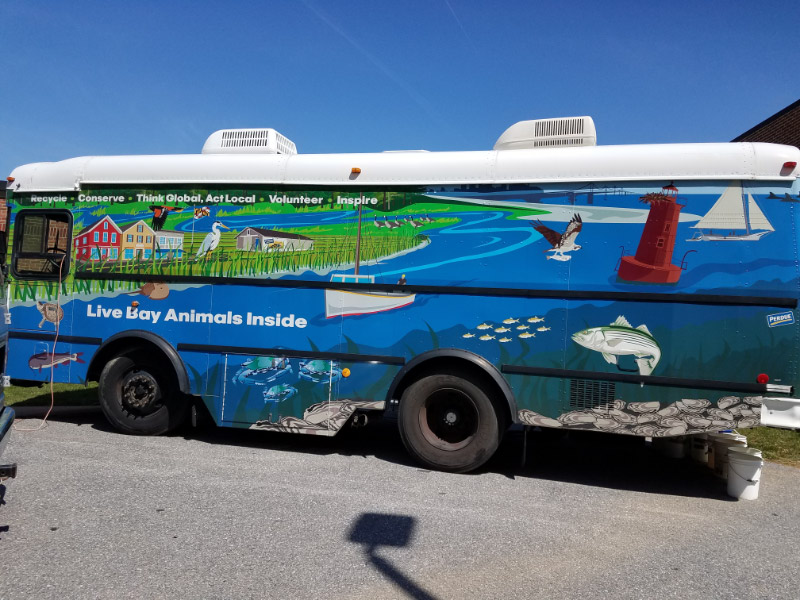
Last week, I volunteered when the Phillips Wharf Environmental Center’s Fishmobile visited an elementary school in Carroll County, Maryland.

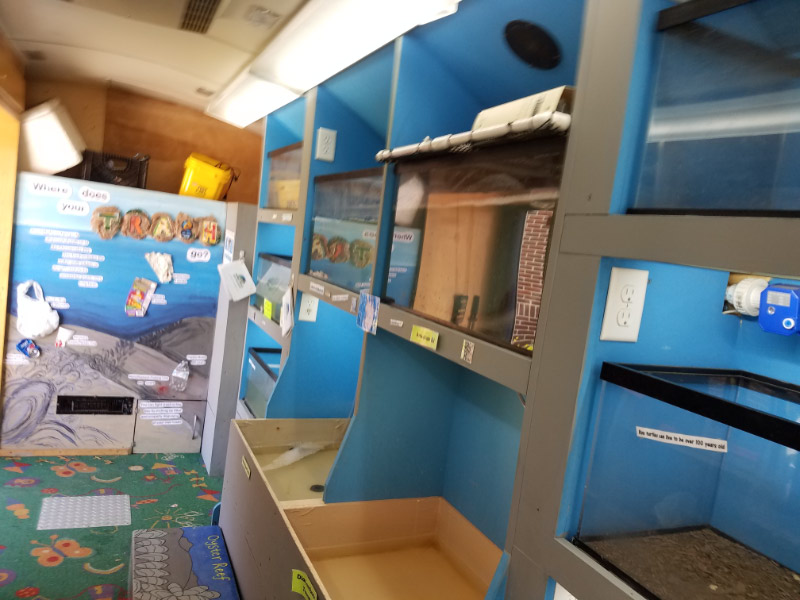
The Fishmobile is a bus fitted with aquarium tanks for live exhibits of animals from the Chesapeake Bay and bookcases/walls of related materials. It’s a field trip that comes to the school! Groups of 10-12 students take about 15 minutes in the bus to see everything…spending another 15 minutes outside getting more details about horseshoe crabs. There were 4 classes of 4th graders that came through in 2 hours!

I managed to take pictures of some of the animals in the Fishmobile before the students arrived. There were small horseshoe crabs – the smallest being a little larger than a quarter. They were active all over the bottom of their tank.

20180406_133203.jpg

The oyster toadfish was not happy after the first few groups and retreated to the back of the tank. I was glad I got a picture of him.

20180406_133213.jpg

The lined seahorse was one that was harder to photograph. It was a good discussion starter since the seahorse depends on the grasses in the bay and is becoming more numerous now that they are recovering. I was impressed that the 4th graders were aware of the grasses even if they didn’t know about the seahorses.

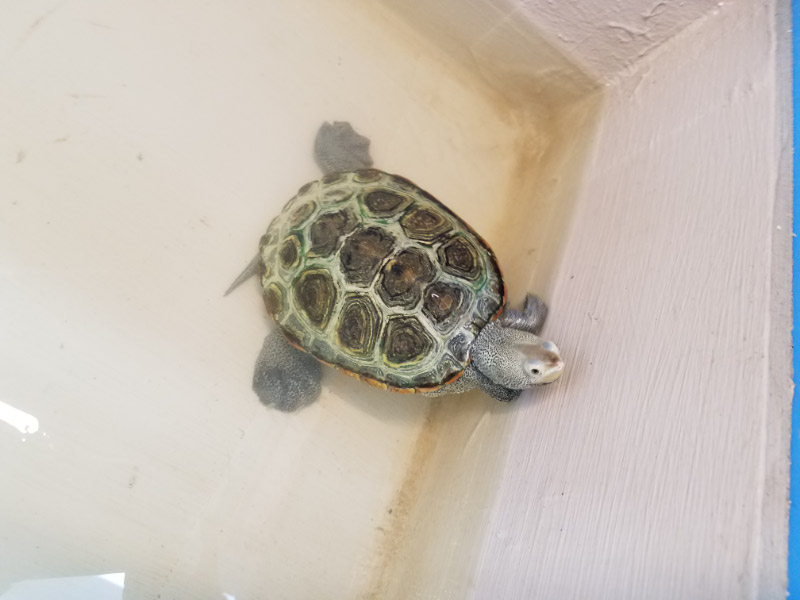
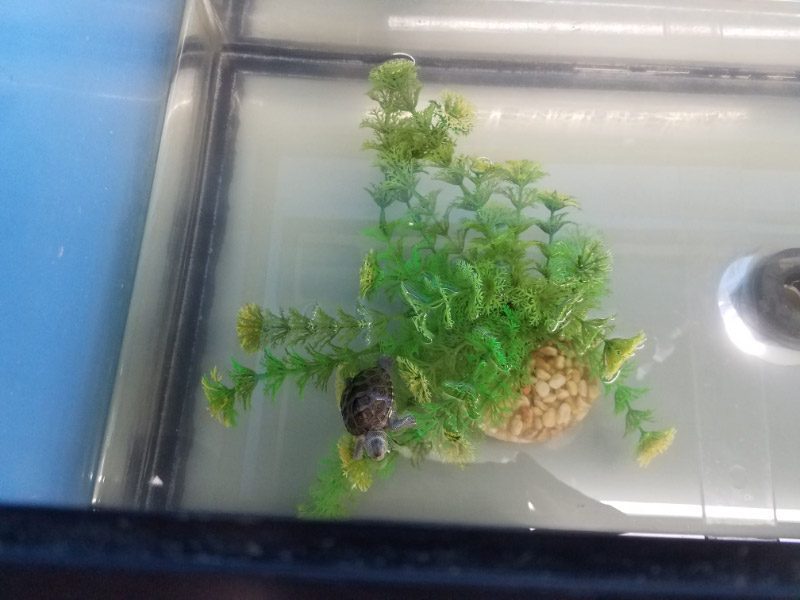
The only animal in the Fishmobile that the students could touch was the diamondback terrapin. They were told to use 2 fingers gently on his back…because he can bite! He evidently is very accustomed to handling…and he has a name: Larry. There was a baby diamondback terrapin (hatched last fall) in a neighboring tank that didn’t move around very much.

There was also a small box turtle and a mystery box with a box turtle shell. We prompted the students that tried the mystery box to feel whether the shell was flat or domed…and then to look at all the turtles on display to identify what kind of shell was in the mystery box.

20180406_133315.jpg

The fish that had a name linked to history was the hogchoker. It is a flounder like fish that lives in the grassy areas of the bay. When the colonists collected the grasses to fee to their pigs, sometimes this fish was harvested with the grasses….and choked the pig that tired to eat it. That’s how it got its name.

20180406_133404.jpg

The bookcases had jaws from a modern shark…and a fossil tooth, a dolphin skull, and the molt of a horseshoe crab. There was a wall of various kinds of trash with estimates of how long it took to degrade. Plastic water bottles and fishing line take 100s of years!

Gleanings of the Week Ending March 24, 2018

The items below were ‘the cream’ of the articles and websites I found this past week. Click on the light green text to look at the article.

Top 25 Migratory Wild Birds – National Geographic Blog – Lots of birds on the move this time of year.

Photobook Captures Diverse Beauty of 100 Different Types of Chickens – Who knew there were so many kinds of chickens!

Some states now advocate coexistence with–rather than killing of–coyotes – National Geographic – We have an overpopulation of deer in our area…and we hear coyotes more frequently. The only time I’ve seen them is a blurring running away from me. I’m cheering them on this spring; maybe they will help limit the size of the deer population.

BBC - Future - Why being a loner may be good for your health – Being alone is not the same as being lonely!

Strange and Unbelievable Facts About Shrews – Cool Green Science – I’ve never seen a shrew – or maybe I just didn’t realize what I was seeing. Watch the 2 videos!

Migrations and Other Colorful Natural Phenomena – Appreciating the natural world…

State-by-state causes of infant mortality in the US: State-by-state analysis links sudden unexpected deaths of infants (SUDI) to high proportion of full-term infant mortality in the U.S. -- ScienceDaily – I was surprised at the variability within the US.

Are Bird Feeders Helping Cardinals Expand Their Range? – Cool Green Science – A positive for bird feeders? I know we have cardinals that visit our feeder area almost every day…all year long.

Historical Sign of Chesapeake Winter, the Canvasback, Still Brightens the Bay – National Geographic – There numbers are greatly reduced…but they still are quite a site. I am already planning a field trip for next winter!

Zion National Park – I came close to visiting this park but the Federal Government shut down that October….it’s a place I’ll eventually visit. It’s also a great place for this article to use for a photography tutorial.

Gleanings of the Week Ending January 27, 2018

The items below were ‘the cream’ of the articles and websites I found this past week. Click on the light green text to look at the article.

Transmission Upgrades & Expansion Are Necessary to Meet Increasing Demand for Wind & Solar | CleanTechnica – The key barrier is planning that requires coordination across regions. The Central US contains the most technical potential for wind and solar development but the largest growth in energy consumption is along the coasts…hence the need for transmission upgrades.

How Birds Survive the Cold: Feathers + Food = Warmth | All About Birds – A timely article about bird survival strategies. I was pleased that I see quite a few of the birds featured in the article in my backyard: juncos, finches, blue jays, chickadees, downy woodpecker, and blue birds.

A Wild Year for the Whooping Crane: The National Wildlife Federation Blog – Still on the edge of extinction…but the numbers in the wild flock that migrate from Canada down to Aransas National Wildlife Refuge is slowly increasing.

Forensic Facial Reconstruction Reveals 9,000-Year-Old Face – It seems like a lot of facial reconstruction has happened recently. This one is for an 18-year-old woman from Greece (9,000 years ago).

People with tetraplegia gain rapid use of brain-computer interface -- ScienceDaily – What a hopeful result – both for people with disabilities and more broadly.

On the Chesapeake, A Precarious Future of Rising Seas and High Tides - Yale E360 – We live very close to the Chesapeake Bay…so I always take note when it appears in my news feeds. The 15-minute video about Dorchester County is well done. I am familiar with Blackwater National Wildlife Refuge; it was the first place I saw a bald eagle in the wild….28 years ago. It has a lot more open water now and by the end of the century will be completely under water.

The Intelligent Plant | The New Yorker – An older article but new to me. It was referenced in a lecture I went to recently. Very readable…a new way of understanding plants.

Understanding the Nomadic Habits of Snowy Owls – Cool Green Science – We only see snowy owls in Maryland in winter…and then rarely. There’s always a possibility.

Canyonlands National Park – I’ve only been in that part of Utah once – and it was in October 2013 when the government was shut down….so I didn’t get to visit the park. This article has given me the idea that it would be a good place to camp – take the telescope for the night skies and hike in the mornings.

Air quality is leading environmental threat to public health: Switzerland tops the report while India falls to the bottom tier -- ScienceDaily – The US places 27th of 108 countries (strong scores on sanitation and air quality…but weak performance on deforestation and greenhouse gas emissions. We’re near the back of the industrialized nations.