Gleanings of the Week Ending April 11, 2026

2/23/2026 I’m Plastic Free Watched The Plastic Detox? Your Guide to Reducing Microplastics Exposure - The Plastic Detox is a powerful documentary exposing the hidden health risks of plastics in our homes. As six couples commit to removing plastic from their homes, the experience transforms their families in lasting ways. The documentary uncovers what microplastics are, how their associated chemicals affect our bodies, and what practical steps individuals can take to regain control over their health.

3/30/2026 BBC Salmon sperm to bird droppings: The science behind bizarre skincare trends - While even the most bizarre of skincare routine fads may have some scientific backing, scientists think that options for the next generation of skincare therapies will involve, among other things, finding new ways to optimize collagen supplementation. Other new therapies are exploring novel ways of manipulating the skin microbiome, the populations of invisible microbes that live on our faces and contribute heavily to the inflammation present in our skin.

3/30/2026 Smithsonian Magazine Sharks in the Bahamas Test Positive for Drugs, Including Cocaine and Painkillers - Sharks in the Bahamas are ingesting drugs—including cocaine, caffeine and painkillers. Scientists identified blood contamination in about one-third of tested animals, findings that further highlight how humans are harming marine environments. While the detection of cocaine—an illicit substance—tends to draw immediate attention, the widespread presence of caffeine and pharmaceuticals in the blood of many analyzed sharks is equally alarming.

3/30/2026 ScienceDaily Simple therapies beat drugs for knee arthritis pain relief - Non-drug treatments like knee braces, hydrotherapy, and exercise can significantly ease knee osteoarthritis symptoms. These approaches not only reduce pain and improve mobility, but also avoid the risks tied to common medications.

3/27/2026 NWF Blog Building hope, organizing communities, and strategic planning on Florida’s Coast - To learn more about the Tampa Bay Coastal Master Plan and efforts to use nature-based solutions to adapt to sea level rise and climate change, with resilient strategies like living shorelines, habitat enhancements, and habitat preservation, please visit this site.

3/26/2026 The Conversation Mosquitoes carrying malaria are evolving more quickly than insecticides can kill them – researchers pinpoint how - The mosquito-borne disease malaria kills over 600,000 people annually. Mosquitoes are quickly evolving counterstrategies that make these insecticides ineffective, putting millions of people at greater risk of deadly infection. Mosquitoes today from Ghana to Malawi are often able to survive insecticide concentrations 10 times the previously lethal dose. Genome-scale sequencing remains important to detect new or unexpected evolutionary responses. The risk of adaptation is highest under a continuous, strong selection pressure, so minimizing, switching and staggering pesticides can help thwart resistance.

3/25/2026 CleanTechnica Why Nature-Based Investments Produce Results - Nature-based solutions have the potential to lift a billion people out of poverty, create 80 million jobs, add an additional $2.3 trillion of growth to the global economy, and prevent $3.7 trillion of climate change damages. Investing in biodiversity conservation and restoring ecosystems have a lot going for them.

3/23/2025 NASA A Fault Line in Bloom – Flowers had turned areas around Soda Lake a bright shade of yellow, and by mid-month, they had spread even farther. Yellow wildflower blooms are visible amid the dendritic network of streams flanking the alkaline lake, which dries out completely during drought years. Colors were particularly vibrant across the Carrizo Plain National Monument, even decorating meadows along the zipper-shaped San Andreas Fault with splashes of purple due to blooms of Phacelia ciliata.

3/30/2026 National Parks Traveler Three Florida Reef Corals "Functionally Extinct" Due To Marine Heat Waves - Extinction has claimed staghorn and elkhorn corals, whose distinctive antler-like arms once peppered the sea floor off Florida but now are all but impossible to find thanks to warming waters and disease throughout their coastal habitat. They are “functionally extinct,” meaning they lack numbers and health to survive threats facing them in the wild. It doesn’t mean they are entirely gone. Scientists are keeping the two species alive in coral nurseries, both onshore and offshore. Many facilities are working to preserve them and raise their offspring as just one aspect of efforts to save the Florida Reef, a 350-mile-long collection of reefs besieged by disease and marine heat waves since the 1970s that have robbed the reef of an estimated 98 percent of its live coral cover. Pillar coral was designated functionally extinct in 2020. On a positive note - elkhorn and staghorn corals typically are ready to move from onshore nurseries into the ocean in about 18 months.

3/30/2026 Yale Environment 360 Even a Few Scattered Trees on Farmland Can Be a Boon for Wildlife - ll told, 58 scientists took part in the effort, using on-the-ground surveys, sound monitoring, and satellite imagery to track close to 2,000 species of birds across more than 1,000 forest remnants. They found that a fragment of forest surrounded by farmland might host more than twice as many bird species as a reservoir island of the same size. 
Gleanings of the Week Ending March 13, 2021

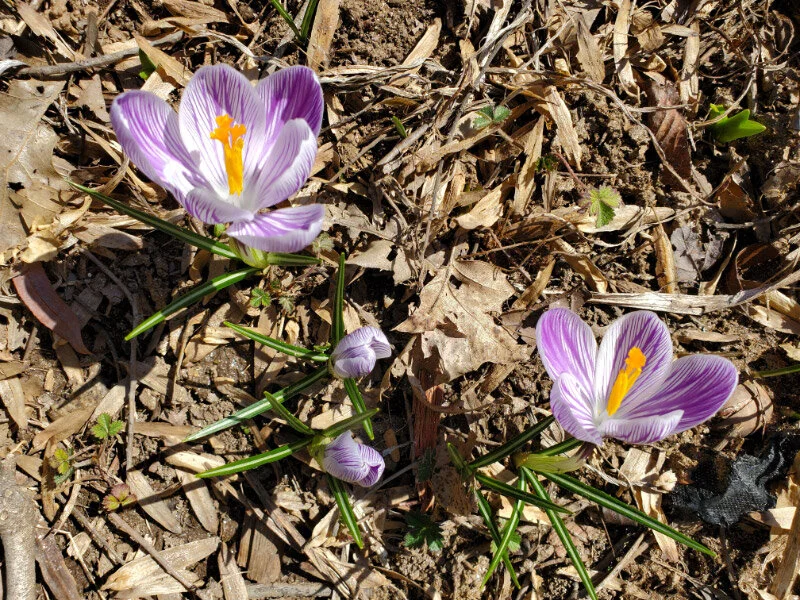
Spring is starting here in Maryland…we have a clump of crocus up and blooming in our front flower bed!

The items below were ‘the cream’ of the articles and websites I found this past week. Click on the light green text to look at the article.

Top 25 birds of the week: March 2021 – Starting off the gleanings for this with bird photographs. I found myself looking at eye color as I enjoyed this group of 25.

Satellite imagery shows northern California kelp forests have collapsed – I had read a story about this previously….but this article include visuals: satellite image and underwater images of what it look like before…and the urchin barrens that are there today.

Kauri trees mark magnetic flip 42,000 years ago | Science – Analysis of a tree preserved in a bog. It lived during the Laschamp Excursion (the last time the poles flipped) The climate instability lasted about 500 years.

Giving Wildlife Room to Roam in the Face of Climate Change – The importance on microhabitats in wildlife conservation particularly as climate changes.

Small Particulates From Burning Fossil Fuels Kills 8.7 Million People Each Year – And this is a form of pollution no one escapes….unless you choose to live in an enclosed and continuously filtered environment (like on an planet that does not support life as we know it). Right now, there are areas outside cities that have lower levels of the small particles in their air but eventually the continued increase in particles and circulation within the atmosphere will spread the ever increasing particles over the entire planet.

Even for Solitary Squirrels, It’s Better to Know the Neighbors – Red squirrels that have the same neighbors year after year…live longer! The study was done in a remote area of Canada over 22 years.

Thanks to Etsy, You Can Now Purchase a Gee's Bend Quilt Online for the First Time | Smart News | Smithsonian Magazine – Folk art…museums…and a modern outlet to improve the artists’ ability to sell their work.

There’s a Koala in the Backyard – A description of what it’s like to have a koala in a tree near homes – serenading.

Geologists Share Their Concerns With Drilling For Oil In Big Cypress – Hopefully the project will not move forward….a national preserve should prioritize the natural environment, not the degradation or destruction of it.  

Eight ways chemical pollutant harm the body – From Columbia University’s Mailman School of Public Health: oxidative stress and inflammation, genomic alterations and mutations, epigenetic alterations, mitochondrial dysfunction, endocrine disruption, altered intercellular communication, altered microbiome communities, and impaired nervous system function.

Gleanings of the Week Ending October 5, 2019

The items below were ‘the cream’ of the articles and websites I found this past week. Click on the light green text to look at the article.

BBC - Future - The desert soil that could save lives – Bioprospecting for antibiotics and industrial biocatalysts from bacteria that survive in extreme environments like the Atacama or Antarctica

Top 25 Wild Bird Photographs of the Week: Resident Birds – National Geographic Society Newsroom – ‘Resident’ around the world….beautiful birds.

Global warming may threaten availability of essential brain-building fatty acid -- ScienceDaily – Impacts of climate change go far beyond the climate models…many probably still to be discovered.

Recovery: Restoring the Floodplain Forest – Cool Green Science – I started reading the article since I am always interested in how restoration projects are created and evolve…but the aspect I’ll remember about it was the info about a tree: American Elms. Ones resistant to Dutch Elm Disease are among the trees being planted as part of the restoration. I grew up at a time when the elms were all dying. There were several I remember at my grandparents’ house in Oklahoma and a tree beside the playhouse at the house we moved to in Dallas in the early 1970s. It was already sickly. I wonder if there will soon be enough varieties and availability of elm trees for them to become landscaping trees again.

Interview: Self-Taught Myanmar Photographer Captures People Working – Capturing images of human-made place. Now I am wondering what I would photograph in my part of the world to do something equivalent.

Crying over plant-based milk: neither science nor history favors a dairy monopoly – An article about milk….and the argument about what the word means. The dairy industry wants it to mean milk from cows…but milk has been used more broadly to mean white liquid for a very long time. We even have plants with ‘milk’ in their name (i.e. milkweed)!

Pictures of India's UNESCO World Heritage sites – Rich cultural and natural history…reflected in places selected to protect.

'Report card' on diet trends: Low-quality carbs account for 42 percent of a day's calories: Older people, those with lower income, and those with less education face greater hurdles -- ScienceDaily – With results like this, maybe we should come up with better ways of helping people learn about nutrition. Do our schools help students learn about nutrition? How many adults have logged their food intake into an app and discovered how good (or poor) their food choices are? The current outreach strategies relative to nutrition are not enough. Sometimes even doctors seem to lack any expertise other than knowing that a patient is overweight/obese or their waist is too large.

Create Wildlife Habitat Around Your House – Cool Green Science – I already have a bird bath and feeder, milkweed patch, brush pile and some native trees (maple, sycamore, tulip poplar, oak). Even a spongy compost pile is habitat (this summer I had puddling tiger swallowtails on it)!

Komodo Dragons Have Skin That Looks Like Chain Mail | Smart News | Smithsonian – Four distinct morphologies of osteoderms in the skin of adult Komodo dragons. Another example of the wonderful complexity in the natural world.

Gleanings of the Week Ending January 13, 2018

The items below were ‘the cream’ of the articles and websites I found this past week. Click on the light green text to look at the article.

Cache of Newly Digitized Travel Photographs Will Transport You to 1900s California | Smart News | Smithsonian – A little California history. I couldn’t figure out how to browse photographs almost like a slideshow. The interface seems to only provide one-at-a-time viewing.

With wrist-worn gadget, researchers capture real-life sleep for the first time -- ScienceDaily – I wondered how this differed from my Fitbit Alta HR tracker. I assume it has more detail and that raw data is processed with more sophisticated algorithms.

The National Gallery of Art Releases Over 45,000 Digitized Works of Art – Wow! Follow the link to the NGA images and enjoy!

BBC - Future - The labs that protect against online warfare – Even with the labs….is seems like we are not doing enough. Governments are serious about the problem from a military standpoint…not necessarily about infrastructure or healthcare.

Habitat on the Edges: Making Room for Wildlife in an Urbanized World - Yale E360 – A good summary of some things that appear to be working to increase and/or preserve wild life habitat even as human populations increase. The habitat is gerrymandered…and different that the original, but may be almost the only path forward.

A Floating House to Resist the Floods of Climate Change | The New Yorker – It seems far fetched that whole neighborhoods would be built like this – but it is appealing to think about non-traditional approaches now when extreme storms seem to be more common.

Deep learning sharpens views of cells and genes – Using a neural network to look at retinal images and determine the likelihood of heart attack…and other applications of high end computer algorithms for improving understanding of medical images.

Badlands National Park – It’s been 20 years since I visited the park. I enjoyed it…think I would appreciate it more now.

National Park Service Begins Roof Replacement, Masonry Repair at Lincoln Memorial – Something going on in DC. The memorial will be partially open during the work.

US childhood mortality rates have lagged behind other wealthy nations for the past 50 years: Leading causes of death are prematurity and injuries -- ScienceDaily – Very sad. We have a system that is expensive and not very effective. Infants in the US were 76% more likely to die than in other economically similar countries.