Gleanings of the Week Ending January 17, 2026

The items below were ‘the cream’ of the articles and websites I found this past week. Click on the light green text to look at the article.

12/28/2025 SciTechDaily Microplastics Burrow into Blood Vessels and Fuel Heart Disease - New research led by biomedical scientists at the University of California, Riverside suggests that routine contact with microplastics — tiny particles released from packaging, clothing, and many plastic products — may speed up atherosclerosis, a condition in which arteries become clogged and can lead to heart attacks and strokes. The team studied LDLR-deficient mice, which are genetically prone to developing atherosclerosis. Both male and female mice were fed a low-fat, low-cholesterol diet comparable to what a lean and healthy person might consume. Over a nine-week period, the mice received daily doses of microplastics (10 milligrams per kilogram of body weight). These exposure levels were chosen to reflect amounts considered environmentally relevant and similar to what humans could encounter through contaminated food and water.

1/1/2026 ScienceDaily This 100-year-old teaching method is beating modern preschools - Public Montessori preschool students enter kindergarten with stronger reading, memory, and executive function skills than their peers. These gains don’t fade — they grow over time, bucking a long-standing trend in early education research. Even better, Montessori programs cost about $13,000 less per child than traditional preschool. (My daughter went to a private Montessori school for preschool-kindergarten…she enjoyed it and did very well in her subsequent education/career so I am not surprised by the results of this national trial.)

12/31/2025 Archaeology Magazine Bones of Chaco Canyon’s Imported Parrots Reexamined – A reexamination of more than 2,400 parrot bones unearthed at Chaco Canyon suggests that most of the macaws and parrots that were kept by ancient Puebloans were likely restricted to the large, multistory buildings known as great houses, where they lived in heated rooms with plastered walls.

12/31/2025 ScienceDaily Microplastics are leaking invisible chemical clouds into water - Microplastics in rivers, lakes, and oceans aren’t just drifting debris—they’re constantly leaking invisible clouds of chemicals into the water. New research shows that sunlight drives this process, causing different plastics to release distinct and evolving mixtures of dissolved organic compounds as they weather. These chemical plumes are surprisingly complex, often richer and more biologically active than natural organic matter, and include additives, broken polymer fragments, and oxidized molecules. Understanding how these chemicals evolve across different stages of plastic breakdown will be essential for assessing their long-term environmental impact.

1/2/2026 National Parks Traveler A Day in the Park: Assateague Island National Seashore – This was a great get away from where we lived in Maryland until recently. We’d cross the Bay Bridge, visit Blackwater National Wildlife Refuge and then be at Chincoteague and Assateague Island National Seashore after that.

1/2/2026 The New York Times A Study Is Retracted, Renewing Concerns About the Weedkiller Roundup - In 2000, a landmark study claimed to set the record straight on glyphosate, a contentious weedkiller used on hundreds of millions of acres of farmland. The paper found that the chemical, the active ingredient in Roundup, wasn’t a human health risk despite evidence of a cancer link. Last month, the study was retracted by the scientific journal that published it a quarter century ago, setting off a crisis of confidence in the science behind a weedkiller that has become the backbone of American food production.

1/2/2026 Smithsonian Magazine When the Bayeaux Tapestry Makes its Historic Return to England - Created in the 11th century, the delicate, 230-foot-long embroidered textile has been in France since 1077.

12/30/2025 YaleEnvironment360 2025 Was Another Exceptionally Hot Year - 2025 was the second hottest on record, surpassed only by 2024. It continues a recent trend of exceptional, unexplained warming. The last three years have been, by a wide margin, the hottest ever recorded. The recent jump in warming, which exceeded the predictions of climate models.

12/21/2025 My Modern Met Photographer Explores the Rich Complexity of Africa’s Great Rift – Photography of a place --- and an interview with the photographer.

12/17/2025 Washington Post These kitchen items may be contaminating your food with chemicals - Plastic ushered in a new era of convenience and filled homes with cheap, disposable goods. But it also has exposed ordinary people to tens of thousands of chemicals that slip out of those items into household dust, food, water — and from there, into bodies. Some of these chemicals are known to disrupt pregnancies, triggering birth defects and fertility problems later in life; others have been linked to cancer and developmental problems. “The problem is, none of the plastics that we have right now are safe,” said Wagner, of Norwegian University of Science and Technology. “That’s not a very nice thing to hear, but that’s what the data tell us.”

12/15/2025 Nature The best science images of 2025 — Nature’s picks – Educational and beautiful at the same time.

Gleanings of the Week Ending July 20, 2024

The items below were ‘the cream’ of the articles and websites I found this past week. Click on the light green text to look at the article.

Why US schools need to shake up the way they teach physics - As the economy becomes more tech-centered, understanding physics is critical. Yet the number of Americans with a solid grasp of physics is dwindling. Learning physics can better prepare you for a role as an aerospace engineer, software developer or environmental scientist, to name just a few. Shifting the way physics is taught so that students see how physics influences their daily lives with examples from sports, extreme weather or baking and cooking rather than rote memorization of formulas with examples from history would increase the number of students mastering physics and prepare them for the future…which is what education should do.

The Smithsonian Acquires the Earliest Known Photograph of an American First Lady – A daguerreotype of Dolley Madison from 1846 when she was 81.

The Hunt: What Happened to the Great Sphinx’s Nose? – The nose was gone well before Napoleon’s time.
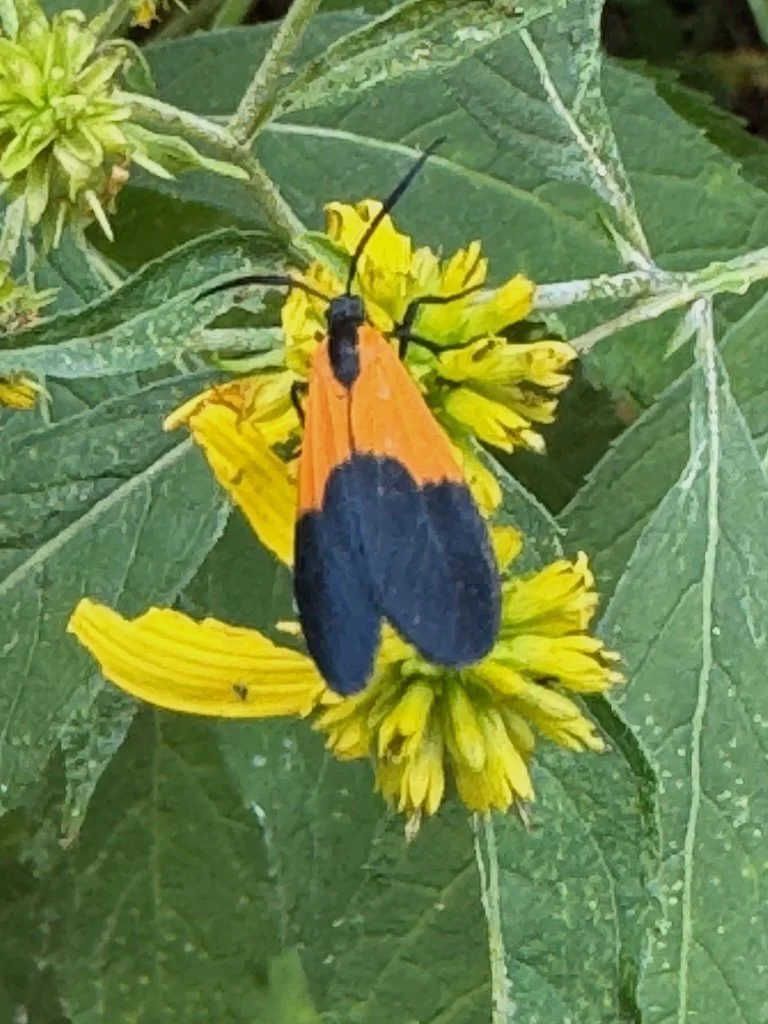
NASA Returns to the Beach: Assateague on the Move – The changes in the barrier islands between 1985 and 2019 shown in images from NASA satellites.

The State of Electric School Bus Adoption in the US – Every U.S. state, except Wyoming, has electric school bus commitments. I hope the adoption has the momentum to continue for the health of child and the environment! As of December 2023, 3,700 electric school buses had already been delivered and 4,800 were awarded/ordered.

Huge firework displays will mark 4 July in the US, but the nation's air quality will suffer - Fireworks generate large amounts of smoke, which can have a visibly negative impact on air quality, but they also release other pollutants that are harder to see. In some areas, the concentration of fine particulate pollution known as PM2.5 can be between 1.5 and 10 times higher than normal on the night of 4 July and the following day. These fine soot particles have been linked to a range of health problems including asthma, heart disease and low birth weight. Another negative for fireworks: One analysis of wildfires on federal land in the US over a 37-year period from 1980 found that 11,294 of nearly 600,000 fires over that period could be attributed to fireworks. Two thirds of these occurred in the two-week period around 4 July. There are concerns that perchlorate (used as a propellent in fireworks) contamination can find its way into drinking water, where high levels of perchlorate can interfere with human thyroid function. --- I hope to see more drone shows available in the coming years.
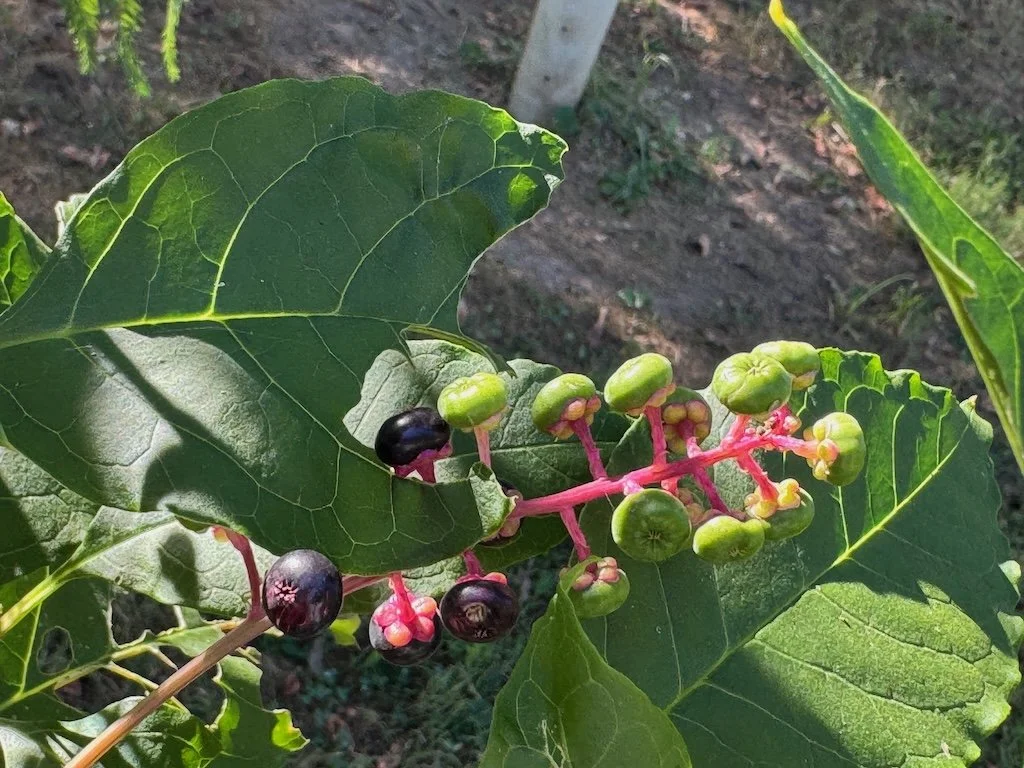
Weaker Ocean Circulation Could Worsen Warming – A new modeling study finds that slowing currents could disrupt the upwelling of nutrients from the deep ocean to the surface, starving the phytoplankton that absorb carbon. The result is that, not only would the ocean absorb less carbon dioxide from the atmosphere, it would also unleash more carbon dioxide from its depths, leading to further warming.

See Ten Awe-Inspiring Images from the Astronomy Photographer of the Year Contest – Beautiful images. My favorite is the solar prominence image.

Proteins and fats can drive insulin production for some, paving way for tailored nutrition - Production of the insulin is much more dynamic and individualized than previously thought. A subset of the population appears to be hyper-responsive to fatty foods. As a next step, the researchers hope to expand their work into clinical studies that would test insulin responsiveness to carbohydrates, proteins, and fats in a real-world setting, and to begin developing personalized nutrition approaches based on the findings.

Clever pupils don't need to attend academically selective schools to thrive – A study from Australia that followed students for 11 years. At ages 19 and 25 there was little difference between the educational and employment outcomes of children who attended selective schools versus non-selective schools. For example, the study found that while 81% of selective school students went on to secure a job or university place at 19 compared to 77.6% of pupils from non-selective schools, this difference disappeared when the students were matched on key characteristics, including socioeconomic background, gender, and geographical location.

Gleanings of the Week Ending January 28, 2023

The items below were ‘the cream’ of the articles and websites I found this past week. Click on the light green text to look at the article.

What links litmus paper and lichens? – How did I not know that litmus dye was made from lichens? I remember using red cabbage to tint paper for an elementary school science project with my daughter. We tested everything in the house…discovered that even the fumes from toilet bowl cleaner turned the strips we made bright pink!

How donkeys changed the course of human history – The beast of burden. During Roman times the subspecies used was larger than modern donkeys…specifically bred for the expanding empire.

Jungle realm of the Snake Queens – A 5-part article about 2 Mayan queens: Lady K’abel and Lady Six Sky.

Marriage in Minoan Crete – A surprise – it was very common to marry one’s first cousin!

Kenya’s Rift Valley lakes are rising, putting thousands at risk – A study reveals that there have been increases in rainfall since 2010…an increase of only 0.4-2% of mean annual rainfall leads to the observed rising lakes/flooding.

EPA requirement keeps electric buses out of low-income schools – Low-income school districts often don’t own their school buses; they rely on contractors or subsidized lease deals. So --- they can’t meet the requirement to scrap the old diesel buses.

Ten-minute scan enables detection and cure of the commonest cause of high blood pressure – The hormone aldosterone causes 1 in 15 cases of high blood pressure. This new technology/treatment is a big improvement for the way those cases can be treated.

Dead Humpback Whale Washes Ashore at Assateague Island – This is the second one recently. I am familiar with the place this time…Assateague Island was a place my husband and enjoyed for birding when we lived in Maryland.

China’s population declines for the first time in six decades – Changing demographics in China.

Bees exposed to common weedkiller via wildflower nectar – Evidently the flowers can be contaminated even if they are not sprayed directly!

Assateague Island Visitor Center

2020 01 IMG_7485 (3).jpg

Our first Delmarva Birding field trip was on the last Friday in January. We parked at the Assateague Island Visitor Center near Berlin, Maryland. It was cold and windy; there had been mist as we were driving but it was dry for the afternoon. They had large table maps of Assateague Island at the visitor center; we’d been to the Tom’s Cove end of the Island (when we went to Chincoteague, Virginia) but had never been to the northern part of the island.

After the group gathered, we headed off toward the Verrazano Bridge which has a nice walk/bike path on a separate span than the car traffic.

2020 01 IMG_7485 (7).jpg

Before we got to the bridge we saw a Mockingbird and then a cluster of Greater Black-backed Gulls as we started up the ramp of the bridge.

2020 01 IMG_7485 (11).jpg

Once on the bridge, there was a lot to see in the water underneath. I managed to photograph a few birds. There were a pair of Horned Grebe (non-breeding plumage) and then I got another as a silhouette in the glints of sunlight.

2020 01 IMG_7485 (10).jpg

A Red-Breasted Merganser (male) was below as well.

2020 01 IMG_7485 (12).jpg

The Bufflehead were numerous but diving a lot. I managed a few pictures…but they were mostly blurs or butts.

2020 01 IMG_7332.jpg

We headed back to the visitor center and then on the trail toward the Rackliffe Plantation House. A Great Blue Heron was feeding in the wetland grasses.

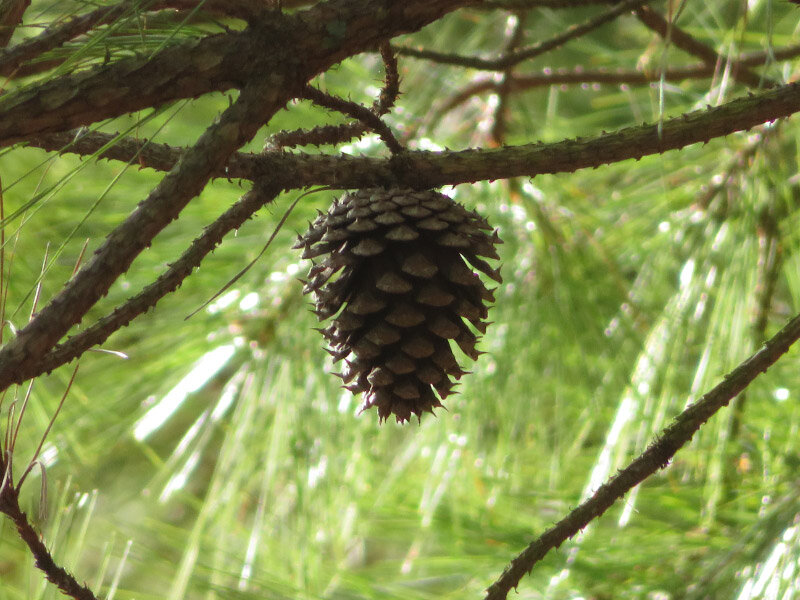
I couldn’t resist a few botanical photos – a pinecone with sun glint needles in the background and a twig with some very curly lichen.

A flock of Brant (a small goose) were avoiding the golfers on the course.

They would fly up occasionally…move a short distance…settle down again.

2020 01 IMG_7485 (29).jpg

Then there were some Eastern Bluebirds that flew into some trees near our group…kept a wary eye on us.

We then hiked back to the visitor center and caravaned around toward the entrance to Rum Point Seaside Golf Links. The ponds had Ring-necked Ducks (and mallard and black ducks).

2020 01 IMG_7485 (30).jpg

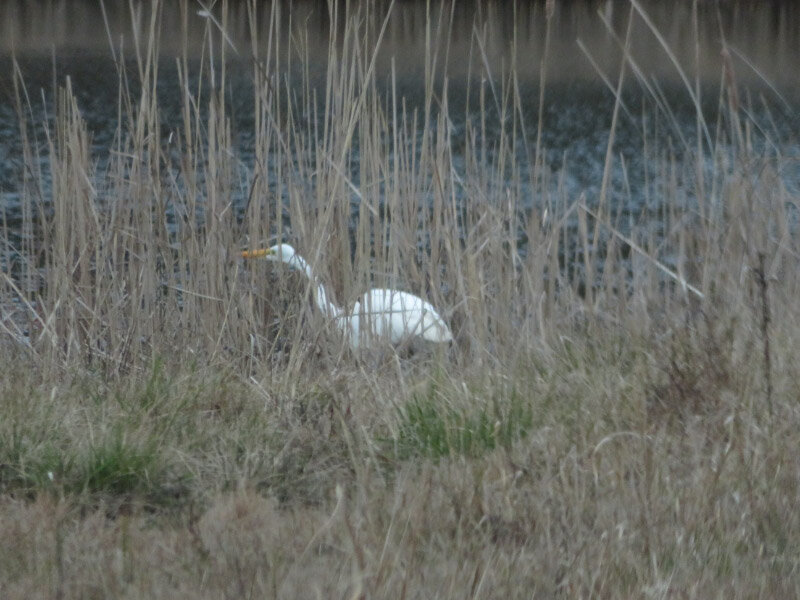
A Great Egret was searching for food nearby.

2020 01 IMG_7485 (31).jpg

There were also some Canada Geese in a field. I am including a picture here to compare with the Brant. The Brant are smaller but they are both geese so have a similar look.

2020 01 IMG_7485 (33).jpg

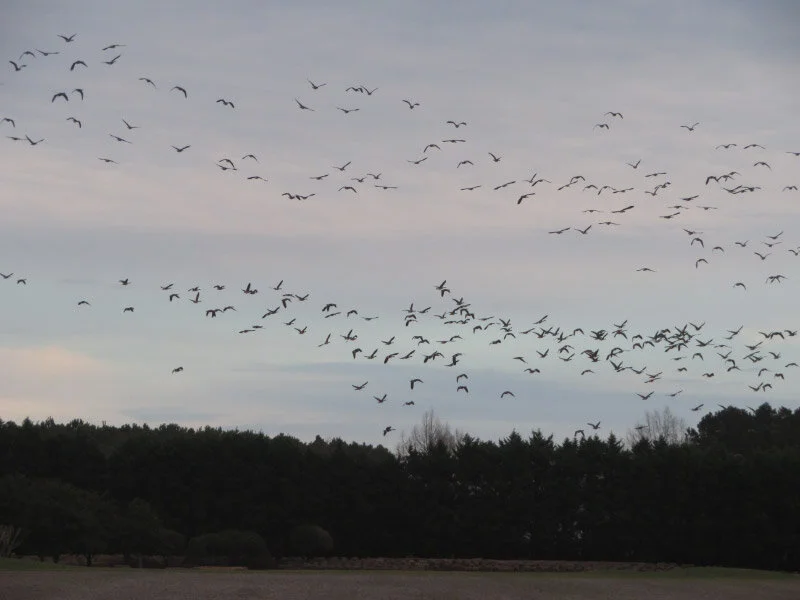
And then the Canada Geese took off…and it was the ending time for the field trip anyway!

2020 01 IMG_7485 (2).jpg